

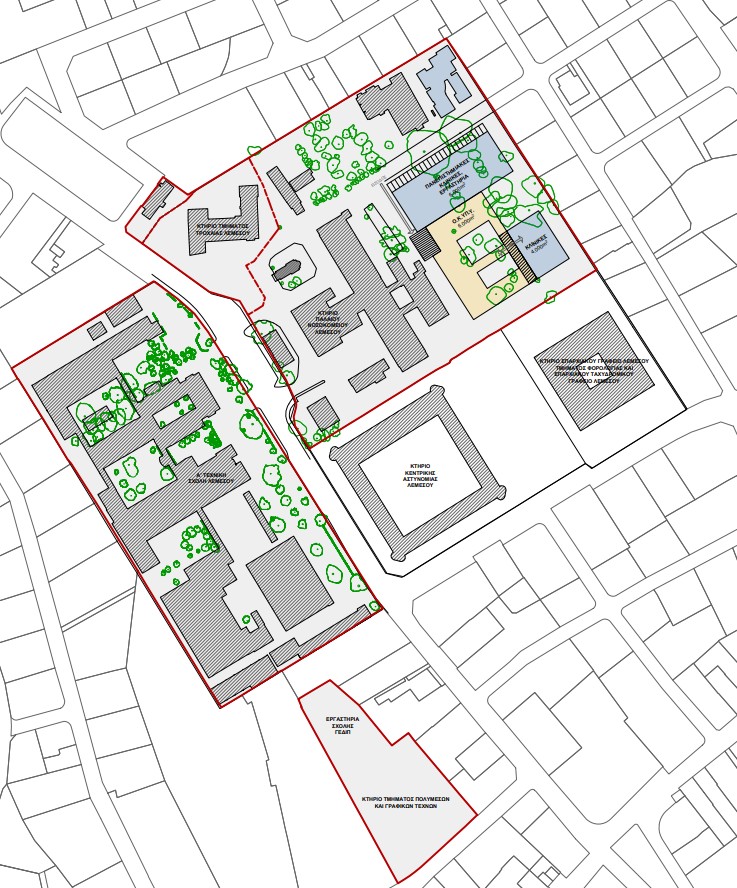
Cyprus University of Technology (TEPAK) is planning a second development pole on the site of the old Limassol Hospital and First Technical School, in a project budgeted at approximately €104 million, Rector Panayiotis Zaphiris has revealed exclusively to philenews.
The development will cover approximately 57,500 square metres of built space and is intended to address the university’s long-term accommodation needs while expanding its capacity in education, research and student life, according to the rector.
The site was formally transferred to the university by a Council of Ministers decision in February 2024. President Nikos Christodoulides reaffirmed political support for the project at a Limassol pan-district meeting in May 2025, stating that decisions had already been taken and the project was ready for implementation, according to the source.
“In recent years at TEPAK we have been moving methodically, in a targeted manner and at a fast pace in the planning required for the development of the spaces transferred by the state for the university’s needs,” Zaphiris said.
What the development includes
The plan encompasses a new building for the School of Health Sciences, housing the Department of Nursing and the Department of Rehabilitation Sciences, which includes Speech Therapy, Occupational Therapy and, in future, Physiotherapy. It also includes a new building for the School of Management and Economics, a Language Centre and Learning Centre with an amphitheatre, a new university school for future use, a 120-bed student residence that can also accommodate visiting academics, recreation and commercial spaces, a crèche, and a maintenance and storage centre.
The listed buildings of the First Technical School will be retained and used as teaching spaces, reading rooms, student club rooms, staff offices, sports facilities, collaborative spaces and a small theatre.
Works must begin promptly, the rector said, as the Technical School will pass into TEPAK’s possession in September 2027, by which point its current students will have moved to new premises.
End to million-euro rental costs
TEPAK currently rents approximately 25 to 30 buildings in the city centre, none of which were designed for academic use, at an annual cost approaching €3 million, according to figures presented by the rector. Transferring schools and services to university-owned facilities is expected to generate significant savings that can be redirected to student welfare, research and academic development.
Health centre partnership with SHSO
A model health centre is also planned for the area behind the old hospital, developed in partnership with the State Health Services Organisation (SHSO). An agreement has already been prepared and a joint working group established, with the aim of creating a facility that will serve the growing healthcare needs of Limassol residents while functioning as a hub for education, research and innovation for the School of Health Sciences.
Architectural competition imminent
The next step is an architectural competition for the masterplan of the Second Development Pole. TEPAK has assigned the process to ETEK, and the rector said the competition is expected to be announced within weeks. The selection process is targeted for completion by mid-September. The outcome is directly linked to the university’s overall infrastructure planning and to financing procedures through the European Investment Bank.
Veregaria residences on track
The Second Development Pole comes alongside work already under way on the Third Pole at Veregaria, where TEPAK’s first university-owned student residences are under construction with a total capacity of 500 rooms. The first 150 rooms are due to be handed over in September 2026, with the full project completing in 2027.
External interference, rector warns
Zaphiris said he was concerned and dissatisfied about what he described as interventions by external parties who, without prior consultation with TEPAK, had approached institutional bodies seeking to reverse decisions already taken by the Council of Ministers and publicly committed to by the President.