

A busy road connecting Larnaca to the Livadia municipal district, classified as primary importance in the Local Plan and earmarked for completion by 2026, will not be ready before 2031, the Department of Town Planning and Housing has confirmed.
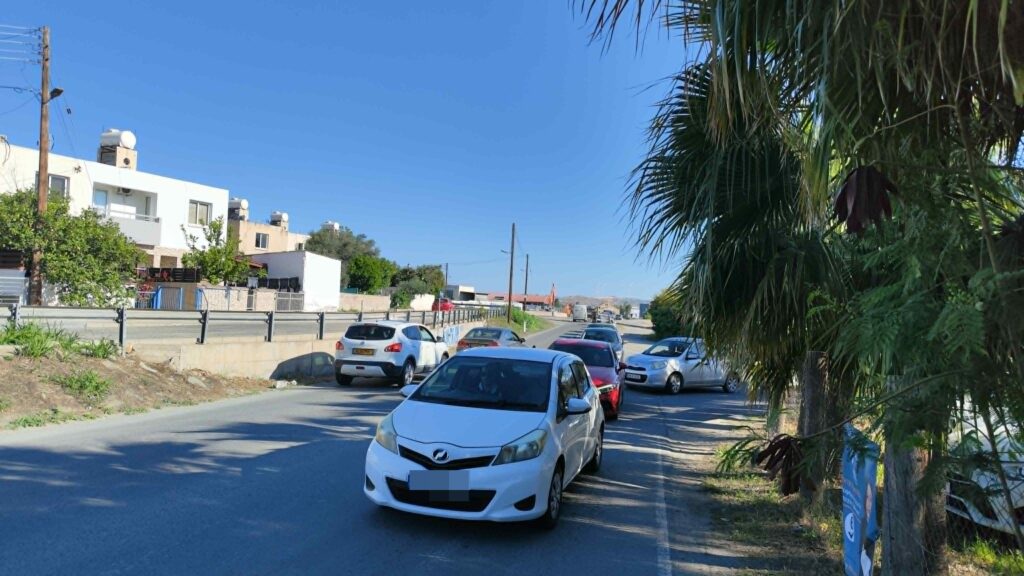
Andreas Mouzakis Street, which links Larnaca to Livadia, has no pavements, no street lighting and runs at reduced width despite rapid development in the area.
The Town Planning Department told Phileleftheros that works are not expected to be feasible within the next five years, even as the road’s Local Plan designation states that primary importance roads were programmed “to be implemented, where possible, by the year 2026, so as to achieve the traffic policy objectives of the Plan.”
Accidents are reported on the road on an almost daily basis, with peak-hour congestion described as resembling central Nicosia. A serious accident at the start of the road last July put a motorcyclist’s life at risk. A similar situation had prevailed on the neighbouring Lysos Santamas avenue, opposite the Antonis Papadopoulos Stadium, where measures were taken following a fatal accident two years ago.
Residents demand action
The situation on Andreas Mouzakis Street has angered residents, who have repeatedly complained and called for measures. Civil engineer Andreas Thrasyvoulou shared with Phileleftheros a recent letter he sent to Larnaca Municipality and other responsible authorities, calling for street lighting, safe pavements, road surface repairs and additional road safety measures.
“Complaints have been submitted repeatedly in the past without any action being taken. Unfortunately, the impression is created that a serious injury or loss of human life will have to occur first before the necessary measures are taken,” Thrasyvoulou wrote. He added that the situation “is not consistent with a modern municipality, which should place the safety of its citizens as a priority.”
Emergency measures from Larnaca Municipality
Larnaca Municipality has decided to take emergency measures while the longer-term solution remains distant. “We see the traffic congestion in the area every day during peak hours and accidents because there is no good visibility. For this reason, some immediate actions have been decided, including clear road markings for pedestrians and the installation of lighting,” said municipal engineer Toula Angelidou, adding that tenders for the work, which will be funded by the municipality, will be issued shortly.
Angelidou also said the municipality will submit a fresh request to the Traffic Studies Authority to examine the installation of traffic lights near the Antonis Papadopoulos Stadium, given the area’s continuously growing population.
The municipality recently received the green light from the Town Planning Department to proceed with a road survey. “We will proceed with the road survey so that Town Planning can adapt a preliminary regulatory plan. The project will be promoted as a town planning project together with Tantalidis Street. Pavements, a cycling lane, bus stops and a green corridor will be created,” Angelidou said.
What Town Planning says
The Town Planning Department acknowledged the road’s deficiencies in its response to Phileleftheros. “In the Larnaca Local Plan this road is classified as Primary Importance, which currently exists on the ground but at reduced width. The total length of the project will reach approximately 2.3 kilometres.
Today the road has two traffic lanes and has the characteristics of an inter-urban road, with serious deficiencies in basic infrastructure such as pavements and modern street lighting, and traffic arrangements along it and at its junctions with other road networks present problems. There are also sections of the road that have not yet been constructed, resulting in unsatisfactory connectivity between areas,” the Department said.
It added, however, that many stages remain before the project can be implemented and that completion “is not expected to be feasible within the next five years.”
Larnaca’s road project hierarchy
Larnaca’s road needs were recently discussed at a meeting at the Town Planning director’s office, where projects were prioritised given the volume of requests. The current ranking is as follows:
The improvement of the Larnaca-Dekelia road, valued at €17.7 million, is the top priority, though the project is already delayed by more than a year, drawing strong reactions from Larnaca’s tourism bodies.
Phase B of Alexandros Panagoulis Avenue — another road connecting Larnaca to Livadia, in an area seeing rapid development near the former refinery site — has been delayed by more than ten years. A preliminary environmental study has been completed and is awaiting assessment by the Department of Environment, while a project note is being evaluated by the General Directorate of Development. The cost is expected to reach €15 million.
The redesign of Grivas Digenis and Grigoris Afxentiou avenues, Larnaca’s central road axis, is also being advanced following a request from Larnaca Municipality. The Town Planning Department previously prepared a regulatory plan, which was subsequently referred to the Department of Public Works for a traffic assessment. That assessment has now been completed and the Town Planning Department will proceed with revisions to the plan.
Further projects under way in the wider Larnaca area include improvements to Phase D of the Larnaca-Dekelia road within the Pyla limits, Kyriakou Matsi avenue in Aradippou Municipality, Vattenas Street in Ormideia, and the northern and southern ring roads in Athienou Municipality.
The Town Planning Department noted that all municipalities in Cyprus and many communities have road improvement needs and that dozens of requests have been received. “Unfortunately, the simultaneous advancement of so many projects is not feasible due to limited financial and human resources,” the Department said, adding that it is working with the Department of Public Works to prioritise needs.