

Hourly-paid government workers staged their first 24-hour strike in the history of the Cyprus Republic on Wednesday, marching from the Finance Ministry to the Presidential Palace to demand wage increases after receiving only 1.5% in pay rises over the past 17 years, according to the unions involved.
Chanting “No to starvation wages” and “No more mockery — we are not second-class workers,” hundreds of workers gathered at the Finance Ministry at 10am before marching to the Presidential Palace, where union representatives handed a memorandum to Government Spokesperson Konstantinos Letymbiotis, calling on the President to intervene and reach an agreement with the Finance Ministry.
The strike drew workers from across the hourly-paid government workforce, including skilled tradespeople, antiquities conservators, construction workers, machine operators, road transport supervisors, cleaning and sanitation staff, forest firefighters, firefighters and lifeguards.
Speaking outside the Presidential Palace, Giorgos Konstantinou, Secretary General of OEKDY SEK, said it was the first time in the history of the Cyprus Republic that hourly-paid government staff had gone on a 24-hour strike. “We are demanding wage increases,” he said, adding that it was unacceptable for the government to treat hourly-paid staff unfavourably while they contributed essential work to the functioning of the state.
Stavros Andreou, Secretary General of PASYEK-PEO, said workers were being paid at minimum wage levels and that 30% of hourly-paid government employees earned up to €1,500 a month. “We demand that the state listen to us and take us into account,” he said. “We demand that the state implement policies that allow workers to live with dignity.”
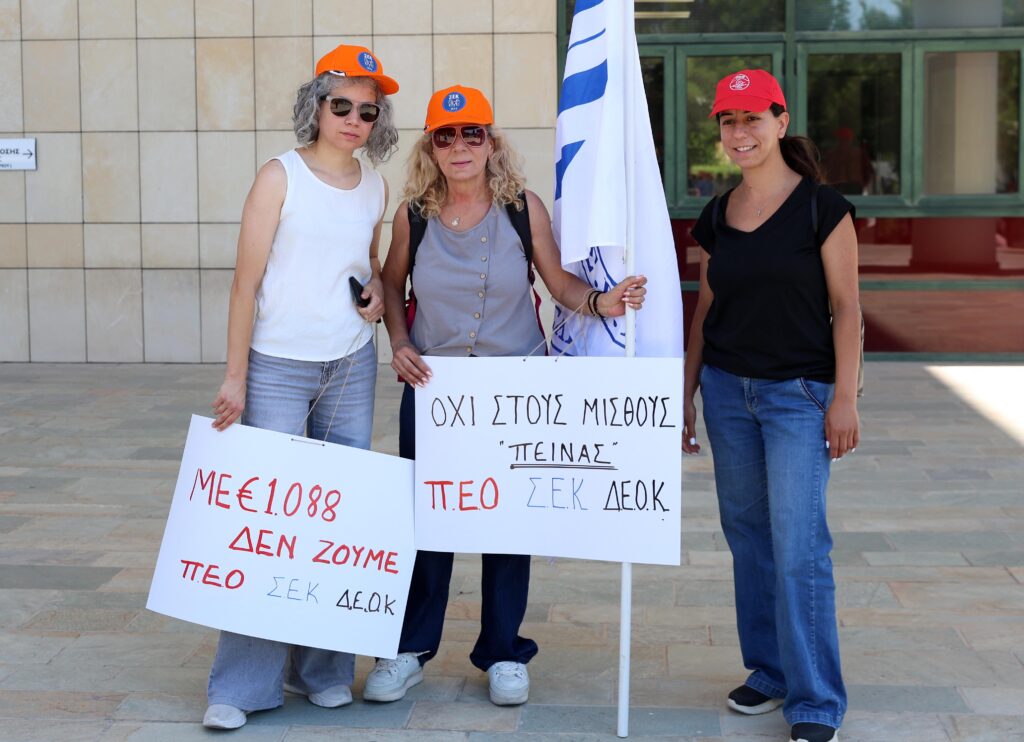
Andreas Antoniou, Secretary General of DEE KDOKO DEOK, said that since 2009 workers had received a total increase of only 1.5%, while Cyprus was recording some of the highest growth rates in Europe. “We are low-paid workers — we cannot meet the demands of the economy on the wages we receive,” he said.
The human cost of the wage freeze was evident in testimonies from workers at the march. A health sector worker said she had been working for ten years and was earning €1,000 a month. A colleague said workers were asking for “the increases they haven’t given us in years” and for “respect and dignity.” A worker with 40 years of service in District Administration said his salary had never exceeded €2,000, describing the pay as starvation wages. Another, with 33 years of service, said he could not afford basic necessities.
A lifeguard said lifeguards were the most disadvantaged group among hourly-paid workers, employed on six-month contracts with no provident fund or other benefits. He said young people were leaving the profession as a result.
In their memorandum to the President, the unions said hourly-paid government wages were significantly lower than those in equivalent private sector roles for the same working hours. They also noted that while the overall public service wage bill had risen, the cost of the hourly-paid workforce’s wages had fallen and was now lower even than in 2011. The unions said wage increase requests had been submitted since April of last year.
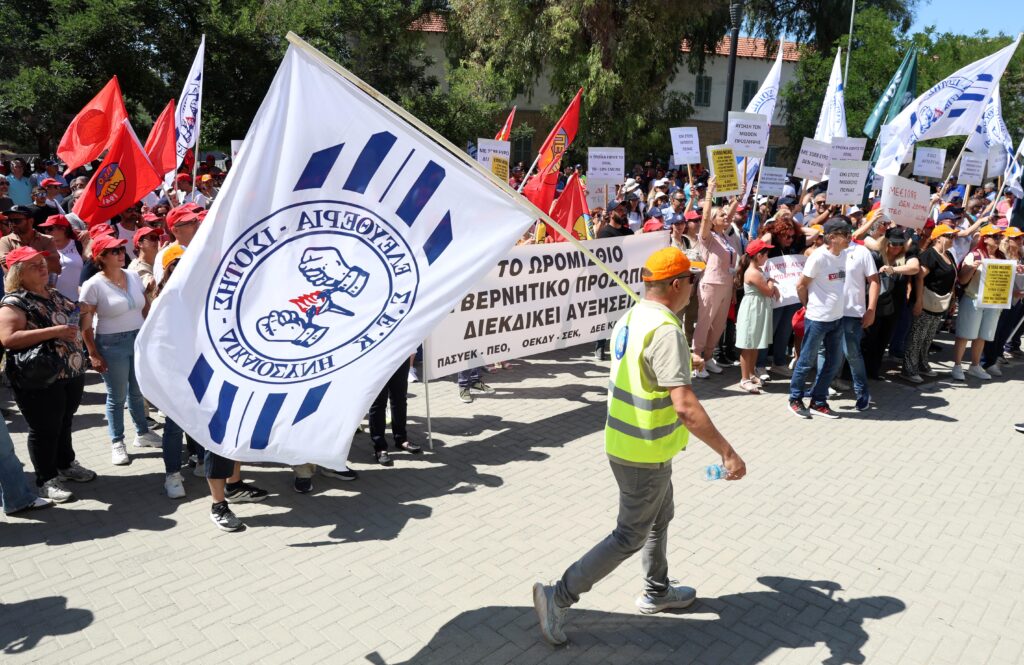
After receiving the memorandum, Andreou said Letymbiotis had committed to passing the unions’ positions to the President and the Finance Minister. He said the unions would give the government time to consider the memorandum, but warned that if there was no positive response and the President did not open a dialogue, they would respond “more forcefully, more collectively and perhaps in different ways.”
Konstantinou said unions had explained to Letymbiotis the importance and role of hourly-paid staff in the state machinery and had received assurances that the President and the Finance Ministry would be informed. He expressed hope that an agreement allowing for wage increases would be reached within the coming days, but warned that if it was not, unions would respond more forcefully.
Government response
Letymbiotis, speaking after receiving the memorandum following the Cabinet meeting, said there were issues on which dialogue needed to continue, but that some of the workers’ requests had been received positively by the Finance Ministry at a meeting the previous day.
He said the government had demonstrated over the past three years its commitment to supporting workers, particularly low-paid ones, citing pay scale progression, the full restoration of the cost of living allowance to 100%, recent tax reforms and a horizontal 1.5% increase across the public sector. “Dialogue continues,” he said.
On comments by Finance Minister Makis Keravnos on a private television channel that the demands submitted were not fully justified and exceeded €50 million, Letymbiotis said that for one of the wage-related requests the cost amounted to approximately €30 million over three years. He said these were amounts that could not be taken lightly and had to be considered in the context of the broader public sector, overall wage levels and the state’s capacity.
(information from CNA)