

A series of strong earthquakes struck Evia on Sunday afternoon, causing structural damage, localized landslides, and widespread concern among residents. The seismic activity was strongly felt across several regions, including Attica.
The activity began at 12:58 PM with an initial 4.8 Richter tremor centered 6 kilometers south of Prokopi, Evia. Two more strong earthquakes followed in the same area shortly after, with the strongest reaching 5.2 Richter. These major tremors were succeeded by at least three smaller aftershocks measuring around 3 Richter in the broader area.
Seismology experts offered reassuring initial assessments while urging localized vigilance. Kostas Papazachos, a professor of seismology at the Aristotle University of Thessaloniki, described the events as “consecutive earthquakes,” noting that northern Evia contains numerous active faults but emphasizing that the tremors should not cause undue alarm.
Seismologist Athanasios Ganas reported that the 4.8 Richter tremor was followed four minutes later by the 5.2 Richter event, which sits at the boundary of a strong earthquake. He explained that the fault line lies behind Mount Kondyli, is well-mapped, and possesses low seismic potential, historically producing tremors between 5 and 5.5 Richter without exceeding 6 Richter. Ganas noted there was no foreshock sequence to provide warning and called for immediate structural checks on older homes in the Prokopi area.
Efthymios Lekkas, the president of the Earthquake Planning and Protection Organization (OASP), confirmed that the Prokopi region historically exhibits high seismicity, often characterized by clusters of tremors over a few hours or days that remain within this magnitude threshold. Lekkas stated that while minor damage and falling objects had occurred in Evia, there was no cause for broader panic. He advised residents to avoid areas with unusual terrain features and to stay clear of old or damaged houses.
The earthquakes caused visible structural and infrastructure issues in the region. Local authorities recorded damage to residential properties, commercial shops, and public infrastructure, along with several landslides along the road network.
Yiannis Tsapourniotis, the Mayor of Mantoudi-Limni-Agia Anna, reported extensive landslides affecting roads primarily in the Plakia and Dafnousa areas, though no injuries had been reported. The Deputy Mayor of Mantoudi, Argyris Liaskos, confirmed that several homes in Dafnousa sustained deep cracks, though residents managed to evacuate safely.
Evia’s Deputy Regional Governor, Giorgos Kelaiditis, highlighted the widespread anxiety among locals, reporting damages to buildings, shops, and the Church of Agios Georgios outside Prokopi, where a baptism was disrupted as attendees evacuated.
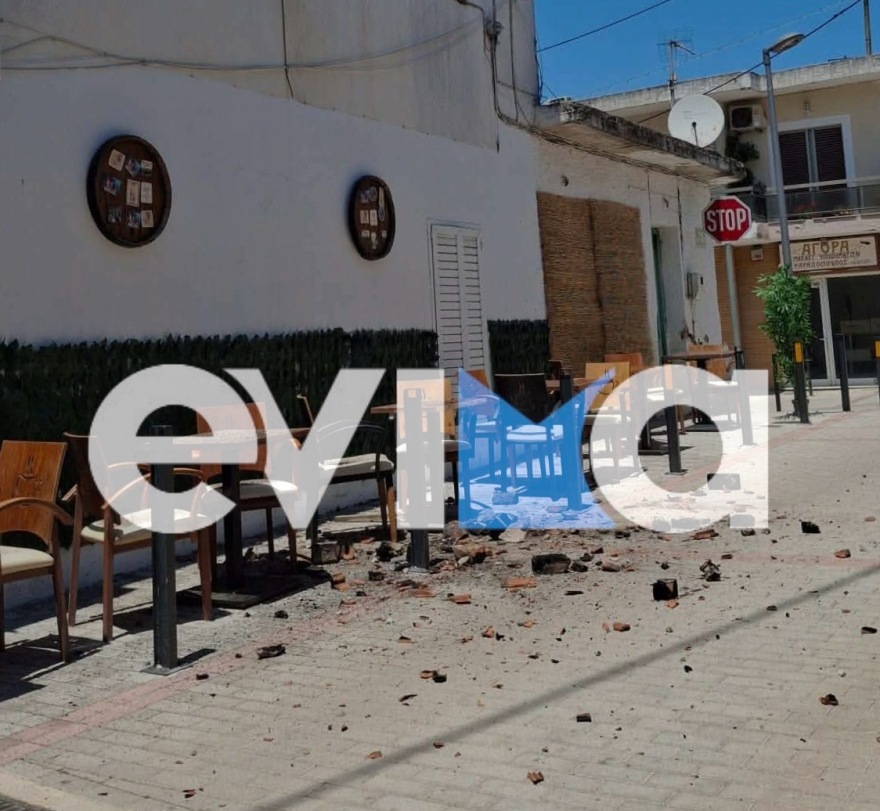
Government sources stated that responding field teams have primarily identified minor residential cracks and limited roadside landslides. Continuous communication remains open between local mayors, emergency teams, and the General Secretariat for Natural Disaster Rehabilitation under the Ministry of Climate Crisis and Civil Protection to assess and manage the aftermath.