

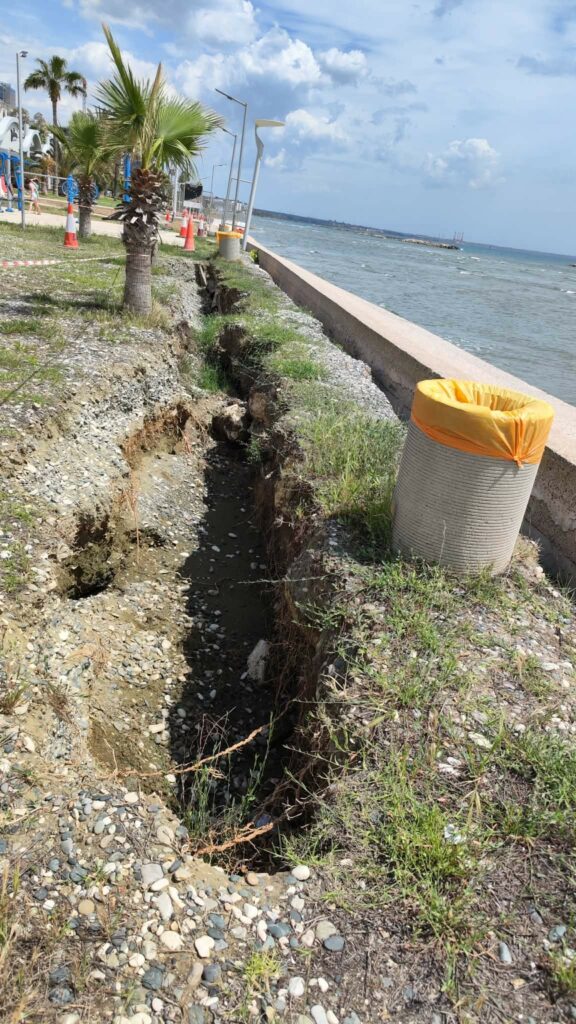
Erosion at Oroklini beach is advancing at a rapid and unpredictable rate, eating into hotel grounds and pushing part of the coastal promenade to the brink of collapse, while authorities have yet to agree on remedial measures.
Photographs show children using an outdoor gym and pedestrians walking beside large holes opened up by the erosion. Larnaca Municipality has closed part of the promenade, a section of which has tilted and is at risk of collapse, but no action plan has been decided.
The situation has compounded the difficulties facing local hoteliers, who are already dealing with the prolonged delays to the Larnaca-Dhekelia road, which has hit bookings during an already difficult period because of the situation in the Middle East.
The Radisson Beach Hotel is among those affected, with holes opening up on its grounds. Marios Polyviou, CEO of SunnySeekers, which manages the hotel, said the problem first appeared last year and nothing has been done to address it.
“All the hotels in the area have been affected. In ours the situation is dangerous, as it is the area used for sun loungers and for guests to access the sea. We have made representations through ETAP, through the Cyprus Hotels Association and as private individuals, both to Larnaca Municipality and to the Public Works Department. This issue was raised last year and May has come and we are still discussing what to do,” Polyviou said.
Coastal engineer Dr Xenia Loizidou, who has been warning for years about the consequences of breakwater placement and concrete promenades near coastlines, said the problem was foreseeable.
She said she raised strong objections when the coastal promenade was being designed, arguing that concrete vertical walls should not be built on or near the shoreline.
“I was ignored and the coastal promenade was built in vertical concrete instead of on piles. Years passed and the Public Works Department designed the removal of a vertical breakwater, which had been creating a stable shoreline position, and the construction of parallel ones instead. It was predictable that the sand that had accumulated to the east of the vertical breakwater would be redistributed,” Loizidou said.
She said what is happening is not erosion in the classical sense but a redistribution of sand caused by changed conditions. “The width of the sandy beach narrowed and the waves started reaching the promenade. That triggered a reflection effect — the wave hits the wall, bounces back and pulls the sand in front of it away until the energy is spent,” she said.
Asked whether the breakwaters should be removed, Loizidou said there are no easy answers. “The problem with dynamic systems is that once you disturb them it is very hard to restore them. The only way to protect the promenade is to armour it by placing rocks in front. But that means there will be no sandy beach. There are no magic solutions. I have nothing to propose, but I tell all municipalities to be careful because breakwaters are not a cure-all,” she said.
She added that had the parallel breakwaters not been installed, the vertical breakwater would likely have maintained a stable shoreline and the current problem would probably not exist.
Larnaca Municipality’s municipal engineer, Toula Angelidou, said the municipality received three indicative solutions at a meeting at the Ministry of Transport, but said they were put forward without a thorough investigation of the causes and the actual situation.
She said the municipality has expressed serious concerns and has asked the Public Works Department to proceed immediately with assessing and implementing appropriate measures.
Angelidou said no local authority has the expertise to study and supervise such works, particularly when it comes to gathering data and studies that formed the basis of previous projects.
She described erosion as a “national issue” requiring a coordinated response, including the involvement of foreign specialists if necessary, rather than piecemeal action by local authorities.
She noted that the promenade was built in the early 2000s, when the affected area had around 25 metres of beach. “Today, a significant section of the promenade is at risk of collapse, while the shoreline has retreated noticeably both in sections where the promenade was built on foundations and in areas where it was built on piles,” she said, adding that it should be investigated whether the potential impact on coastal balance had been adequately assessed before the vertical breakwater was removed.
Stelios Zervos, former head of the Marine Works Branch and now deputy director of the Public Works Department, defended the work carried out in the area, saying all projects were preceded by studies.
“Based on the models, it was decided to reinforce the three existing breakwaters, since the beach was receding, and to remove the vertical one, because that way the balance of the beach would be restored. It is already evident from measurements that the sand held by the vertical breakwater has begun to be distributed across the rest of the area,” he said.
Zervos said the department is in contact with Larnaca Municipality and has already put forward proposals for protecting the slope. “We are looking at the issue again because we were told the erosion has advanced. Teams have gone back to the area and we will come back to the municipality with recommendations on what can be done,” he said, adding that the Marine Works Branch will provide technical assistance.
He noted that when the Oroklini coastal promenade was designed by the Town Planning Department, the Public Works Department had raised objections, saying its standing position is that interventions near the water should be avoided wherever possible and that promenades should always be built as far from the water as possible.