

The story of 16-year-old Foteini and her mother has moved many, after the pair found themselves at the centre of a “chain of life” organised in Israel, in which four people of different nationalities and religions gave the most precious gift, donating a kidney to four patients in need of a transplant.
Three of the donors were relatives of the recipients, while the fourth, who completed the domino transplant circle by giving his kidney to Foteini, was an altruistic donor.
Speaking to philenews, Foteini’s mother, Panagiota Vareli, recounted the events, expressing her gratitude both to the other six people who took part in the chain and to the medical staff in Cyprus and Israel who helped them.
According to Vareli, “Foteini has been ill since the age of three and a half due to a rare genetic syndrome, which arises from DNA mutations and causes nephrotic syndrome. It’s a corticoresistant syndrome, meaning it didn’t respond to corticosteroids, cortisone or other treatments.
“Over the years we tried various medications, following the protocols and instructions of the doctors, combined with diet and frequent hospital checks. But because the genetic mutation affects the kidney filters, over time both kidneys were gradually destroyed and began to fail. So over the last two years we reached end-stage kidney failure.”
She told us that Foteini was initially monitored at Makarios Hospital by Dr Ilias Avraam, who urged them to begin the transplant process. After his retirement, Dr Eftychia Thodi took over Foteini’s care.
According to her mother, she is “an excellent doctor, who did what needed to be done. With her advice and changes to the medication, we managed, more or less, to keep the situation under control, and we began the process of looking for a graft.”
Initially, Foteini’s father was going to be the donor, as he had the same blood type and was compatible. However, after a series of tests, he was judged unsuitable as a donor. Panagiota was not compatible with her daughter, so, working with Dr Thodi and Nicosia General Hospital, they began looking for a donor so that a “crossover transplant” could take place.
That is how the process began. But no one expected that, in the end, eight people in total would take part in the chain.
As Panagiota tells us, she herself hadn’t imagined anything so large. “When I spoke to the doctors here afterwards, they told me they had carried out several domino operations in previous years. But this was one of the biggest, since on the same day eight people underwent surgery, four donors and four recipients.”
Two postponements came first
Before reaching the successful transplant, carried out a few days ago, there were two postponements.
According to Vareli, they were initially told a compatible donor had been found.
“That happened after we had already been to Israel twice. The first time we went so the little one could have certain tests, and the second time we went before a committee, which has to approve the process and confirm that you’re giving your kidney of your own free will and that you understand the act you’re about to carry out.
“In the meantime, we also met the girl who would be the donor, who was a volunteer. We were then told the transplants would take place on March 2 and that we would be travelling on March 1. But on February 28, the Iran war began. We were told immediately that we wouldn’t be travelling, because there were no flights.”
This, however, did not discourage Foteini’s mother. As she says, she wasn’t disheartened when the process was cancelled the first time, since her overriding thought was that if it wasn’t happening then, it simply wasn’t the right moment.
“I kept saying God knows something. And in the end He certainly did, because the outcome was amazing. From what would have been me giving my kidney to one person and another person giving theirs to my child, we ended up being eight people.”
As she said, “months passed, and then we were told the war had stopped and that efforts were under way to find the right pairs, so we could go to Israel on June 8. But that date changed too. In the end, we travelled to Israel on July 7, and the operations took place on July 13.”
The transplants were carried out successfully, with the medical marathon lasting more than 12 hours, starting at 5am and finishing at 7pm.
The “chain of life” and Asaf’s altruism
Panagiota placed particular emphasis on the fact that her daughter’s donor was a volunteer.
“He’s an altruist. He didn’t expect anything in return. What Asaf did is a godly act, and I’m grateful to him and to his family,” she told us.
Fifty-two-year-old Asaf Mor, a father of four, is Israeli and lived for many years in the United States. In recent years he returned to Israel and had expressed interest in becoming a donor.
According to Foteini’s mother, “thanks to him, the circle was completed. They actually asked him whether it bothered him to give his kidney to someone of a different religion, since there are certain restrictions, and he answered: ‘No, it doesn’t bother me at all.’
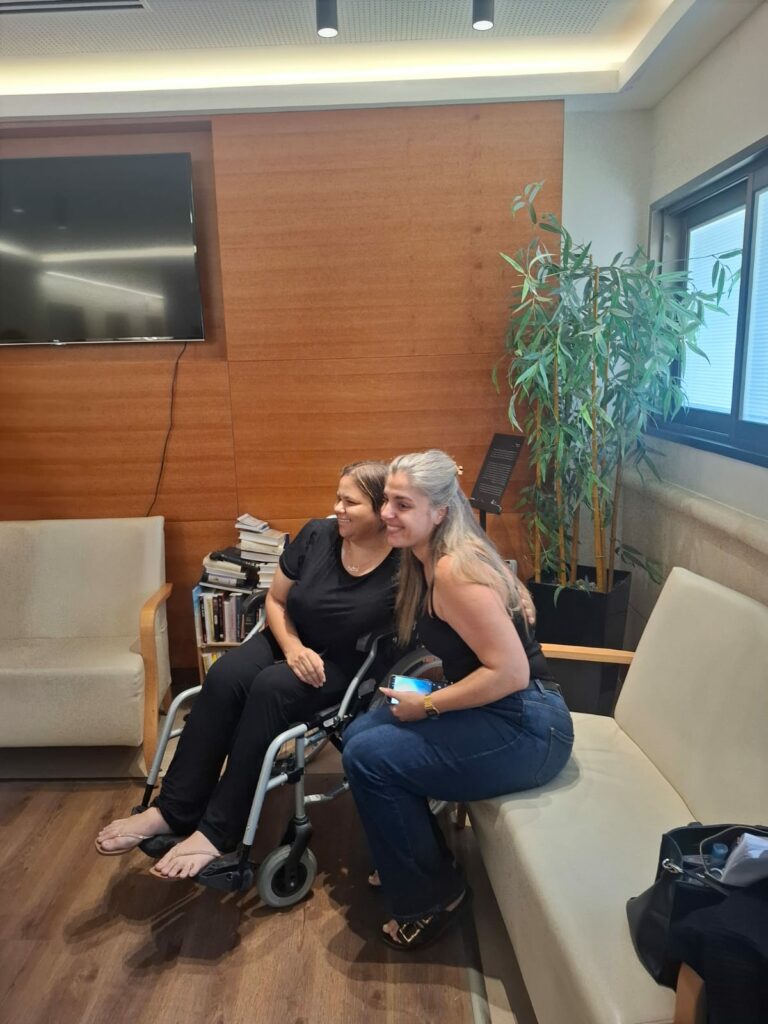
“As soon as he found out it was a 16-year-old girl, he immediately volunteered to give his kidney, since his youngest daughter is the same age as my daughter.”
“Apart from being grateful that someone was found to save my child’s life, I’m glad that I, in turn, was also able to help a young person,” Panagiota tells us.
As she explains, she gave her kidney to 27-year-old Hana Saaban, who had been searching for a compatible donor for many years. Hana had already had a transplant from a deceased donor, but lost the kidney after contracting Covid-19.
Hana’s husband, Ali, then donated his kidney to a man named Nael, while Nael’s wife donated her own kidney to Orit.
In this way, a chain of four transplants was completed, linking an Israeli donor, a family from Cyprus, and recipients of different faiths — Jewish, Muslim and Christian.
“What I did, I would have done for my child anyway. But I’m grateful that I was able to help someone, and that some people were able to help me, and that it resulted in one big chain that helped eight people,” Foteini said.
An exceptional experience at Israel’s hospitals
The operations were carried out at two hospitals, with Foteini’s mother expressing her thanks to the medical staff and other personnel, who, she said, were “incredible.”
“My daughter’s operation took place at Schneider Hospital and mine at Beilinson, since the first is a paediatric hospital. Both are located in a huge complex with many hospitals. I go to see my daughter, but I can’t stay for many hours, because I need to lie down.
“Both my own experience and the experience at my daughter’s hospital were exceptional. We’ve been to many hospitals. Before we moved permanently to Cyprus with my daughters, when we lived in Greece, we went to Ioannina University Hospital and to the Aglaia Kyriakou Children’s Hospital in Athens, while Foteini was also treated at Makarios Hospital.
“But what I saw here, in Israel — without wanting to diminish our own hospitals — is something incredible. The kindness and service, from the cleaner to the doctor, were exceptional.”
“I consider them my family”
As for what comes next and their state of health, Foteini and her mother are recovering in Israel and looking forward to returning to Cyprus.
Panagiota was discharged last Thursday, while her daughter remains hospitalised.
As she says, “we need to stay in Israel for a month, both for monitoring and for a follow-up procedure that needs to be done. If all goes well, we’ll be able to return home soon.”
Asked about Foteini, she told us she “is a happy child, who was looking forward to the process happening. She’s better. The first few days were hard, since it was a painful operation. But we’re on a good path. We’re recovering and looking forward to going home.”
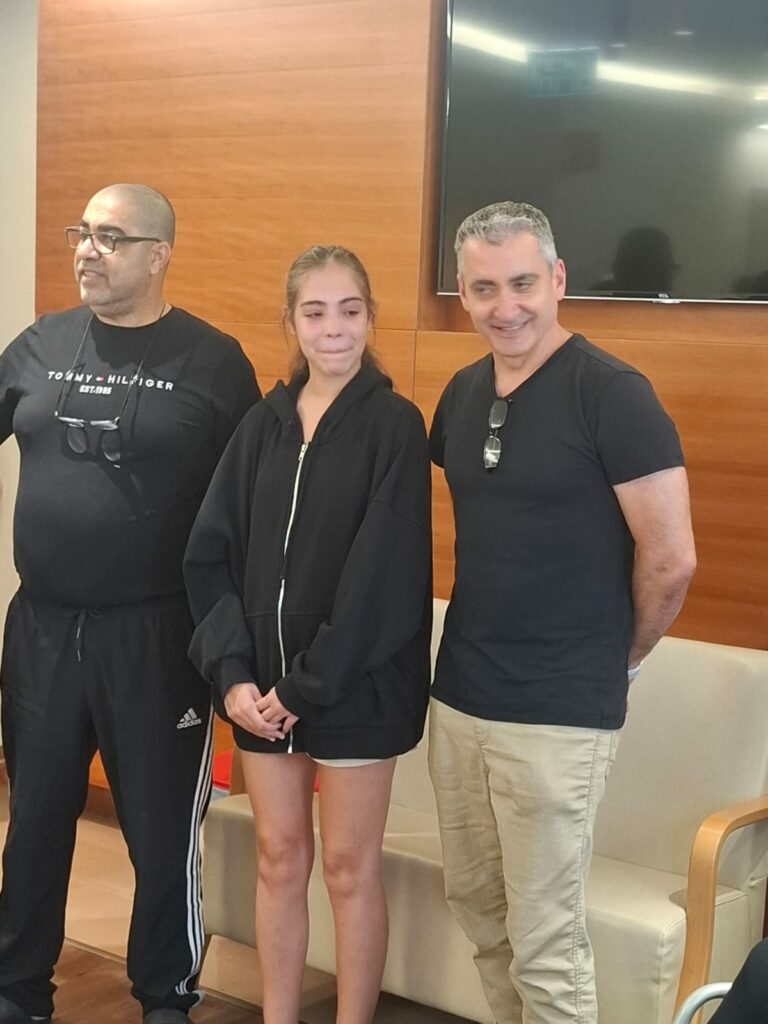
Referring to the other donors and recipients who took part in the transplant chain, she said they remain in touch with everyone and that she now considers them her family.
“We hope the next time we come to Israel it will be for a holiday, to see our new friends, and not for medical reasons, because we’ve been through a lot over the years.”
What’s wrong in Cyprus…
In closing, Vareli stressed that something needs to change in Cyprus too regarding altruistic organ donation, so that donations don’t only come from deceased donors.
“It isn’t right that, in the year 2026, altruistic donation of a kidney, liver or any other organ that can be given willingly isn’t allowed. It’s a matter of vital importance. There isn’t enough awareness about organ donation in Cyprus, and people aren’t familiar with it.”
The second issue she wanted to raise is that “it isn’t right that the whole of Cyprus has only two paediatric nephrologists.”
As she said, “it would be a blessing if that excellent team from Israel could come to Cyprus, as used to happen in the past.”