

With a device that could sabotage satellites and clean up space debris, the Spanish artist is looking to open up a conversation about the privatisation and militarisation of space. As part of his residency at the NeMe Arts Centre, he talks to Phileleftheros about invisible surveillance infrastructure, control of information, and the role of art as a tool for critical thinking.
What influence did the environment you grew up in have on your artistic perspective?
I grew up in a small village in the mountains of Spain, surrounded by tools because my father had a very nice workshop, and we used to work together to develop some inventions for the local farmers. But it was my mother who had more of a taste for aesthetics; she used to draw and sew. It was a very creative environment. At sixteen years old, I moved to the nearby city to study art.
Did you grow up with enthusiasm for technological progress or with a more critical attitude towards it?
I have always been interested in technology, especially in understanding how it works; it was like magic to me. I started with the most basic mechanics; it was my father’s hobby, and I learned from him how to repair all kinds of things and lose the fear of opening car and motorbike engines. I think I was quite excited at that moment.
During my time at the Art University, I became interested in theorists and philosophers of technology, such as Gilbert Simondon and Lewis Mumford. I did a master’s in Visual Arts and Multimedia in Valencia, Spain, and another in Interface Cultures in Linz, Austria, where I learned some electronics, coding, and more critical theory. I think one step brought me to the other. I discovered post-media authors such as José Luis Brea, Félix Guattari, and Andreas Broeckmann, and I started to build the base of my critical position.
Was there a period when you believed more strongly in the promise of the internet and digital freedom?
Yes, at the beginning, the Internet was a space of freedom, but it has clearly turned into the opposite, a space of surveillance. This situation is due to the physical infrastructure of cables and data centres got privatised by companies with a long trajectory in data exploitation. I describe it in detail, in an article I published titled “Infrastructures of Dissidence: Artistic Tactics Against Internet Monopolies”.
Most users experience technology through screens and applications. When did you begin to take an interest in the systems and infrastructures behind them?
I got to know some authors like Wendy Chun and Geert Lovink, then I attended a conference in a fascinating festival called AMRO in Linz, the keynote was delivered by Tatiana Bazzichelli, I knew her activities in Disruption Lab, the conference was about deep cables, after the conference I had the idea to develop a project to give the internet user the possibility to stop internet, just in case it would be necessary. I called the artwork FUCK-ID. Free Universal Cut Kit for Internet Dissidence and consisted of a speculative design of a device powered by underwater currents that is capable of cutting undersea internet cables. F.U.C.K.-ID serves as a critical design concept to shed light on issues of control and surveillance, visualises the sociopolitical effects of the Internet’s physical infrastructure, and gives users back the power to decide about their data and privacy. In essence, it is the Internet’s stop button.
Do you feel that people today are becoming more aware of the technologies they use, or the opposite?
Yes, the people are informed, but even though the technical mechanisms are so complex and hidden by multiple layers that users normally lose sight of the effects of their/our digital activity. A clear example is the Bitcoin infrastructure: people speculate by buying and selling cryptocurrencies, but on the other part of the network, there is an infrastructure of computers (miners) that consumes as much electricity as a country like Argentina.
Do you see a contradiction in using digital tools in everyday life while simultaneously questioning digital systems of power?
Whether digital or not, human beings use tools. If we understand tools as devices that help achieve a purpose, I do not see a problem with using tools. The problem lies in how, for what purpose, and by whom those tools are used. Yes, there are many contradictions in everyday life. For example, a mobile phone is an incredible tool for communication and many more functions; it is somehow a tool of tools if we think of the possibilities of all apps have to help people to communicate, navigate or date, but at the same time these apps have been used for Cambridge Analytica to leak digital assets, such as “Facebook likes,” to benefit its clients during the electoral process. These practices have been termed Surveillance Capitalism by Shoshana Zuboff, leaving users defenceless. These technologies are developing faster than the laws and regulations, but also faster than the critical thinking we require to use them prudently. Here I see another functionality for the art.
The work you will develop is titled Free Universal Cleaning Kit for Satellite Decolonisation (F.U.C.K-SD.). How did the idea emerge?
FUCK-SD is the continuation of the previous project F.U.C.K.-ID (Free Universal Cut Kit for Internet Dissidence), a device powered by ocean currents that is capable of cutting undersea internet cables. The idea is the same, but this time it is transferred to space.
What has the development process for this work been like?
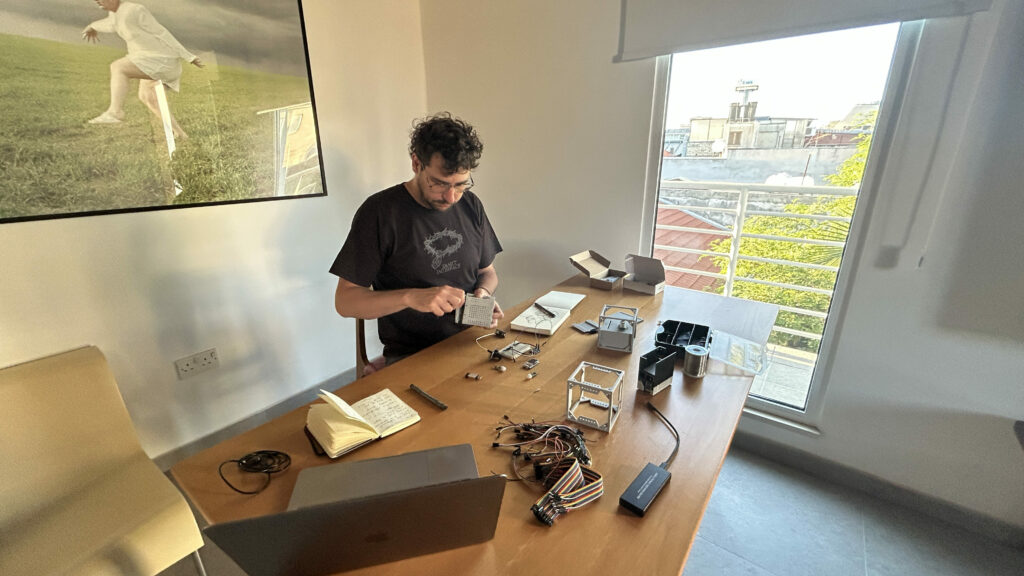
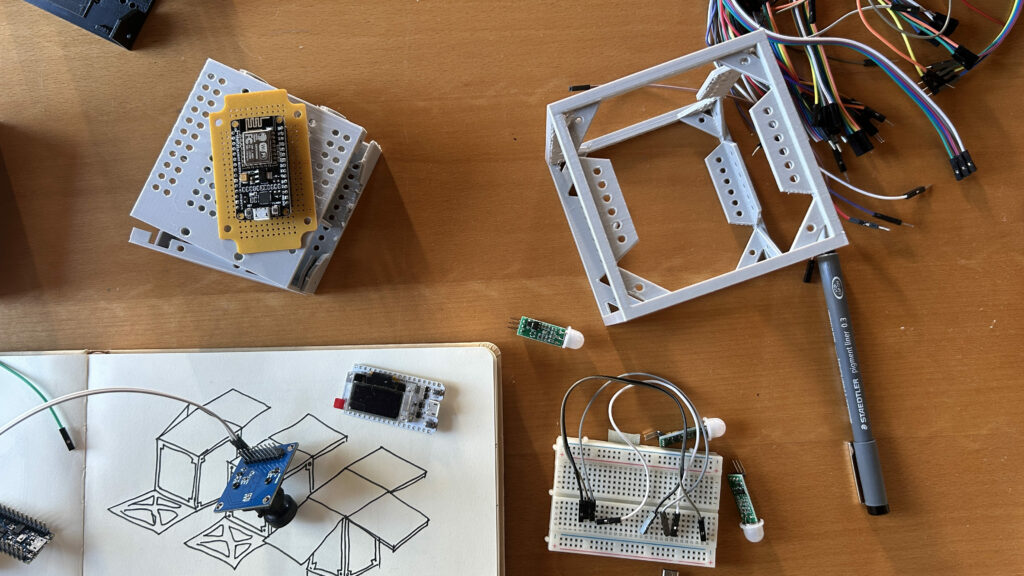
I will work with Charalambos Margaritis, an artist and researcher, to develop the first phase, which consists of developing technical drawings for each part of the device and adapting them to the 3D environment; then I will proceed to the second phase, which focuses more on electronics and coding. The process is fascinating because I am learning a lot of things about building satellites, and yes, it is quite challenging. I am considering extending it to include video documentation and diagrams. I am very happy to receive support from NeMe, a cultural NGO well known worldwide for its substantial contribution in supporting and promoting critical activities in new media, within the framework of the European Media Art Platform (EMAP) residencies.
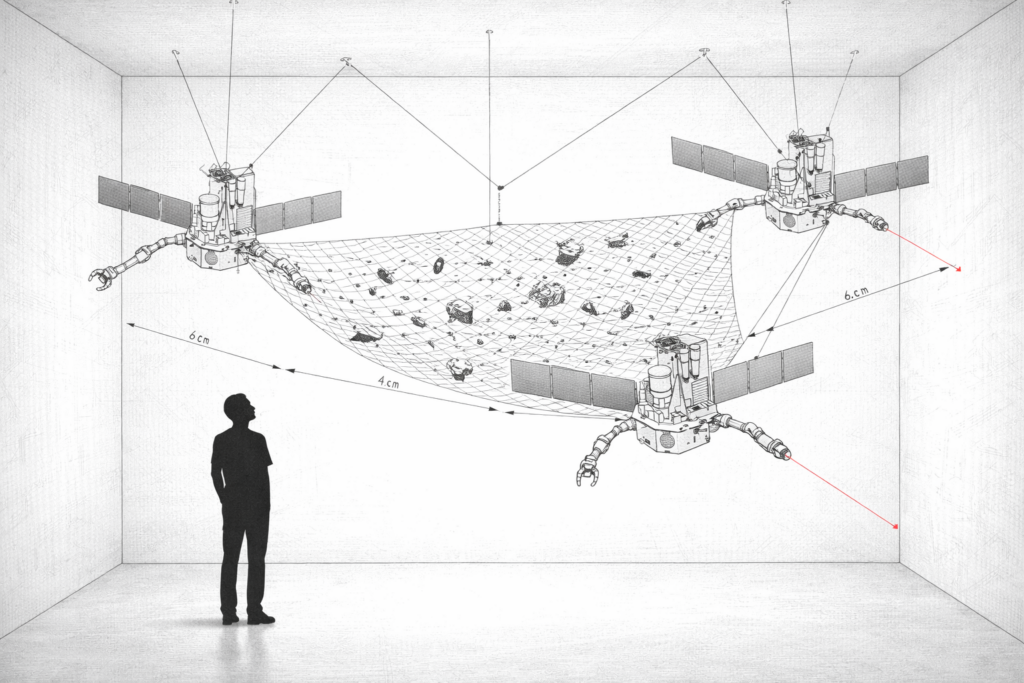
You describe the work as a speculative autonomous device powered by solar panels that could sabotage satellites and clean up space debris. What kind of conversation are you inviting the audience into?
The expansion of big tech companies is transforming space into a militarised, privatised territory. An example is the Starlink project, a network of 10,000 satellites launched by SpaceX. By analysing Starlink, we can draw critical conclusions about how a weaponised platform operates and how Starlink’s orbit colonialism is creating a new layer of dependency and centralised control. The question is no longer just who controls the internet, but who controls the sky, and how we can reclaim both. In this sense, by speculative and critical thinking, we can confront scenarios to create narratives that prompt the audience to consider how Big Tech are using space. Which kinds of strategies are they using to colonise it? Which mechanism of regulation exists? How can this become a situation of control and surveillance?
The work speaks about the “decolonisation” of satellites. What does this term mean to you in today’s technological and political context?
Space is a common area, and it has been occupied by those with more resources to make more profits. On May 24, 2019, SpaceX began launching satellites, aiming to reach a total of 10,000 to create a network of satellites called Starlink. This change is not merely technological but ideological, as it reinforces patterns of techno-imperialism and monopolistic control. In the context of my project, decolonise means dismantling the pattern of techno-solutionism and visualising the real purposes behind Starlink. So in this case, it is an ideological decolonisation.
Public discourse often presents outer space as a neutral field of science and progress. Which political or economic questions do you think are left out of this discussion?
Yes, it is true: some satellites are used for scientific research to understand important issues like climate change. But the idea of neutrality is quite blurred. In reality, space is more like the Wild West, where Big Tech companies spew technosolutionist discourse as a promise of common benefits, but it is driven by their business models and the desire to make profits. For example, Musk’s Starlink offers global internet coverage to help areas devastated by natural disasters or other regions where humanitarian aid is urgently needed. But in November 2023, Musk said that Starlink service would only be provided to Gaza with the approval of the Israeli government. In addition, the height of techno-imperialist hypocrisy was manifested when Elon Musk declared that “Starlink has to be a civilian network, not a combat participant.” To that end, in December 2022, SpaceX announced Starshield, a sub-brand of Starlink that allows the U.S. Department of Defence (DoD) to own Starshield satellites for partners and allies. So your question is: what political or economic issues do you think are being overlooked in this discussion? My answer is all of them.
Are there aspects of the region or local realities that interest you?
Cyprus is an internet and surveillance hub for the region. Israel’s internet backbone cable, for example, comes from Cyprus. At the same time, Britain has some of its most vital spying installations installed on the island that used to be part of Echelon, which was formalised in the 1960s, and now, according to Snowden’s leaks, it is part of SSEUR, a 14-country spying alliance. In Cyprus, it includes the now well-known radio antennas in Akrotiri and the station in Mount Olympus, as well as the documented but less well-known Torus antenna in Dhekelia. This antenna, unlike regular spherical ones, has multiple focal points and can capture multiple signals simultaneously. At the same time, and because of its geopolitical position, the island is vulnerable to constant interference with its communication systems. For example, the GPS in some areas of the island appear to be permanently interfered with by Israel, which jams the signal and redirects the location to Beirut airport. The country is also known in some communities as the “island of spies” where actors from multiple nations are in the international news on a regular basis.
Your work moves between artistic research, speculation and technological critique. What can art achieve that journalism cannot?
My projects are based on academic and journalistic research, and afterwards I transform this knowledge into other media, sometimes speculative design, sculptures, or diagrams. One of the things art does is impact the audience in a different, more direct and visceral way. Sometimes related to emotions and other feelings, and finally to more actively opening questions to be answered by each one.
In times of war, what do you believe is the role of the artist?
The role of the artist begins before a war and consists of creating realities to prevent it.
Do you believe that today, control over information is as critical as control over territory?
Jean-François Lyotard, in his essay “The Postmodern Condition,” already wrote about that in 1982. Both information and territory have been critical topics since the beginning; the difference is that territory has been more or less the same, whereas today’s information is produced, captured, and analysed in ways never before seen.