

In a small country like Cyprus, ambition often begins quietly.
For many young people, the idea of studying at the world’s leading universities or building a career on an international stage can feel distant. Not because the talent isn’t there, but because the pathways are not always visible.
And yet, more stories are beginning to emerge. Stories of young Cypriots who step beyond those perceived limits and find themselves in places once thought out of reach.
One such story starts in Cyprus and unfolds in Cambridge. This is the story of Mara Rotaru.
Now studying Engineering at one of the world’s most prestigious universities, this young student represents a new generation that is reshaping what is possible, not only for themselves, but for those who follow.
Her journey reflects something larger: a shift in mindset, where ambition is no longer constrained by geography.
We spoke with her about her roots, her journey so far, and what drives her forward.
Mara, let’s start from the beginning. Tell us a bit about your background and what first drew you to engineering.
I grew up in Limassol, in a household where curiosity was just part of the air. My dad would take computers and appliances apart just to see what was inside, and my mum would bring up history or interesting maths problems at the dinner table. So questions were always welcome. I think that environment planted something in me early on.
However, the real turning point for me was Lego Robotics. My brother and I signed up for a competition called the First Lego League, and that experience of building something, breaking it, rebuilding it, and then presenting it to judges was the first time I understood what engineering actually feels like. It wasn’t about following instructions. It was about thinking, failing, and trying again.
When it came to choosing what to study, I wanted something that would genuinely stretch me. Engineering felt right, not because I saw myself as an inventor, but because I liked finding patterns, solving problems, and understanding how things work. It felt like a natural continuation of those early Lego years.
Looking back, when did you first realise that you wanted to aim beyond Cyprus and pursue opportunities abroad?
I think it crystallised in Houston, Texas, at the First Lego League World Championship in 2019. Walking into that competition hall was genuinely overwhelming. The robots were extraordinary, the research projects were sophisticated, and the other students were passionate and driven in a way I hadn’t encountered before. We didn’t score as highly as we’d hoped, but that almost didn’t matter.
What that experience gave me was something I couldn’t have found in a classroom in Cyprus: a real glimpse of what a culture of curiosity and innovation looks like at a global level. It opened a door I hadn’t known existed. From that point on, I think something in me understood that the world was much larger than my immediate surroundings, and I wanted to find my place in it.
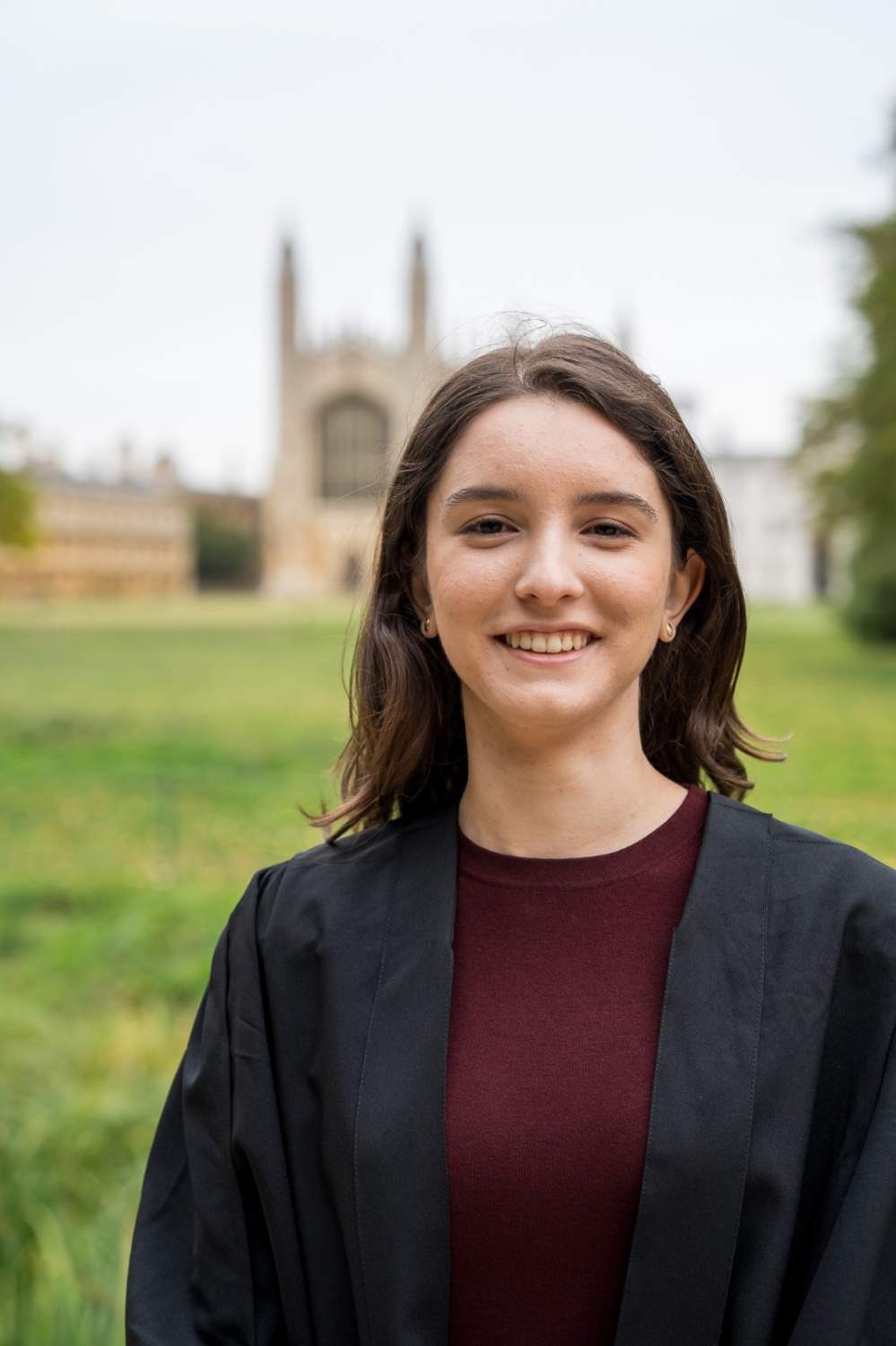
Studying at Cambridge is a milestone few achieve. What has that experience been like so far, both academically and personally? Any challenges along the journey?
I arrived with enormous excitement and very little strategy. I was running towards every open door I could find, which, looking back, was an overflow of having worked so hard towards one goal for so long. On the first day, I joined thirty clubs. Thirty. So naturally, it took me a while to learn the difference between exploring and scattering.
Academically, one of the things nobody really warns you about is that engineering intuition isn’t something you arrive with. It’s something you build slowly, through iteration and failure. You can follow the maths perfectly and still have no feel for why something behaves the way it does.
I also came in without Further Maths A-level, so many of my peers had a head start that was hard to ignore at first. But that actually forced me to understand my own learning process much more deeply: how I absorb new material, what problems motivate me, when to push and when to step back and consolidate. I think of building intuition a bit like developing an ear for music. It comes from doing it badly, then less badly, and always asking not just “did I get the right answer?” but “do I understand why and when would it stop being right?”
At some point in your journey, you received support through the Exness Fintech Scholarships. How did that opportunity shape your path?
Quite simply, it made Cambridge possible. When I found out I’d been accepted into the University of Cambridge, the excitement was real, but it was quickly followed by a quieter, heavier question. Could I actually afford to go? A few scholarship rejections had come in, and for a while, I was carrying that uncertainty alongside the achievement. When Exness agreed to support my Undergraduate studies, Cambridge stopped being an abstract milestone and became something real and liveable. The Exness team was also incredibly supportive and equally as excited as I was to pursue my ambitions of studying mechanical and aerospace engineering.
You’ll also be speaking at the Doers Summit in Limassol. What can people expect from your talk? What message do you want to share?
I want to tell an honest story about what it really means to build your own curriculum, and how to become someone who keeps learning and adapting rather than endlessly racing to stay relevant, especially in a world being reshaped by AI. I’ll be sharing three lessons from my own journey: that curiosity is a genuine asset, but it needs direction, that knowing yourself as a learner is just as important as knowing your subject, and that the best professional relationships are built on genuine interest in people, not strategy.
Finally, what would you say to a young person in Cyprus who has big dreams but isn’t sure where to start?
Break the dream down. A big ambition is only overwhelming when it stays abstract, so map it out, make it visible, and identify the first concrete step you can actually take. The path reveals itself in the doing, not the planning.
Then be deliberate about how you learn. Use AI as your mentor and assistant. It’s an extraordinary resource for anyone willing to engage with it seriously. But use the time and energy you save to go and find your people. Real mentors, genuine conversations, humans whose thinking genuinely lights something up in you. AI can accelerate your learning but people will change the direction of it.
And then, build, reach out, iterate, and repeat! Don’t wait until you feel ready, because that moment rarely comes. The interesting journeys almost never start with certainty. They start with curiosity, a willingness to be bad at something new, and the courage to walk through a door before you know exactly where it leads.