

Cypria Auctions presents a trio of exceptional textiles in its Winter 2025 sale — three museum-worthy examples that reflect the artistic, cultural and technical richness of the Eastern Mediterranean from the 16th to the 19th century. Each textile comes from a distinguished private Greek collection and appears fresh to the market.
Rare Ottoman Silk Brocade Kemha Panel
Late 16th century
Estimate: €4,000–€6,000
A superb example of Ottoman kemha — one of the most prized silk fabrics produced in imperial workshops during the 16th century, the golden age of Ottoman textile production.
Woven in rich tones of crimson, gold and pale blue, the panel displays a repeating arrangement of large and small ogival medallions with intricate internal decoration. The finesse of the weave, the metallic threadwork and the architectural clarity of the pattern echo parallels found in major international collections.
Comparative scholarship includes parallels with a 16th-century embroidered satin kerchief published by Walter Denny in Tulips, Arabesques & Turbans (New York, 1982, pl. 150).
A minor segment from this textile was exhibited at Turkophilia, Paris (2011) and appeared at Sotheby’s An Eye for Opulence sale (2012, lot 163).
The panel stands as a rare surviving witness to the cross-cultural influences that shaped Ottoman luxury fabrics at the height of their aesthetic refinement.
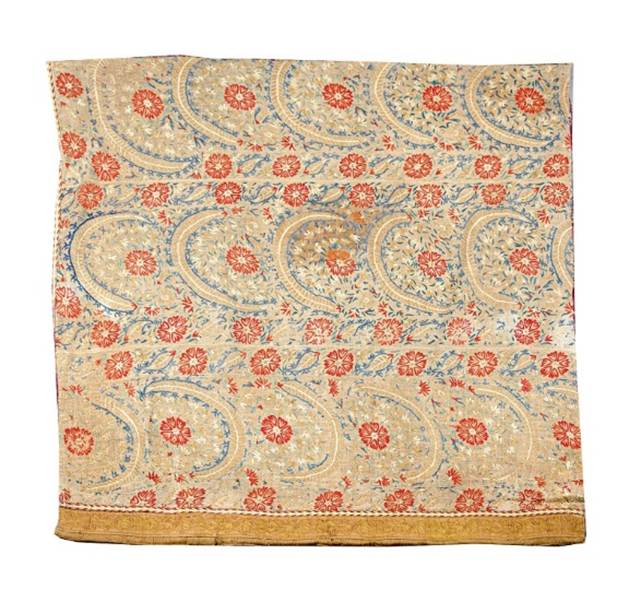
Epirus Embroidered Panel
Epirus, late 18th / early 19th century
Silk on linen
Estimate: €1,200–€1,500
This embroidered panel, composed of borders from an original bedsheet, is a fine example of Epirus needlework — one of the most recognisable schools of Greek textile art.
Executed in herringbone, chain and outline stitches, the design reveals the region’s characteristic floral vocabulary: stylised rosettes, leaves and geometric borders arranged in rhythmic dialogue. The pattern was drawn directly onto the foundation fabric, a traditional method that allowed embroiderers to improvise within established forms.
Comparable examples are found in A. J. B. Wace’s landmark study Mediterranean and Near Eastern Embroideries from the Collection of Mrs F. H. Cook (London 1935, vol. II), which documents related Epirus motifs and compositions.
Preserved with clarity and colour integrity, the panel is an elegant testament to the domestic artistry and symbolic inheritance of the region’s women embroiderers.
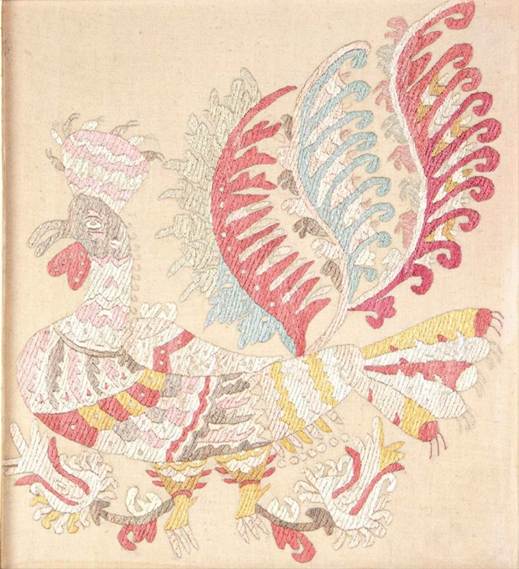
Skyros Embroidered Cushion Cover (The Great Cockerel)
Skyros, Northern Sporades, 18th century
Coloured silk on linen (plain weave)
Estimate: €2,500–€3,500
A striking embroidered cushion cover depicting the celebrated “great cockerel of Skyros,” one of the island’s most powerful folk symbols. Rendered in vivid coloured silks, the cockerel — with its exuberant tail and upright stance — symbolises fertility, independence and vitality.
This motif is the most iconic subject in Skyrian embroidery, frequently interpreted as a coded emblem of resistance during periods of Ottoman rule.
Scholarly parallels include:
- Angeliki Hatzimichali, Greek Popular Art I: Skyros (1925)
- Benaki Museum, Greek Embroideries (1980)
- Roderick Taylor, Embroidery of the Greek Islands and Epirus (1998), pp. 96–97:
“The most spectacular and attractive of all natural creatures is the great cockerel… a secret symbol of independence and pride.”
The present example, with its balanced composition and excellent state of preservation, is representative of Skyros’s most desirable folk textiles.
Auction Information
Date: 10 December 2025
Time: 7:00 PM
Location: Gallery K, Nicosia
Public view: Until 10 December 2025
Catalogue: cypriaauctions.com
Bidding: In person, online, or by telephone