The genocide in Gaza has reshaped the political landscape of the Middle East, bringing renewed focus to the future of the Palestinian national project, the credibility of international institutions and the viability of a political settlement.
Dr Sabri Saidam, a member of the Central Committee of Fatah and its Deputy Secretary General, as well as a member of the PLO Central Council, is regarded as one of the most prominent political and technocratic figures within the Palestinian Authority. He previously served as Minister of Telecommunications and Information Technology (2005–2006) — becoming one of the youngest serving ministers in Palestine at the time — and later as Minister of Education and Higher Education (2015–2019). He also acted as adviser to the Palestinian President on telecommunications, IT and technical education.
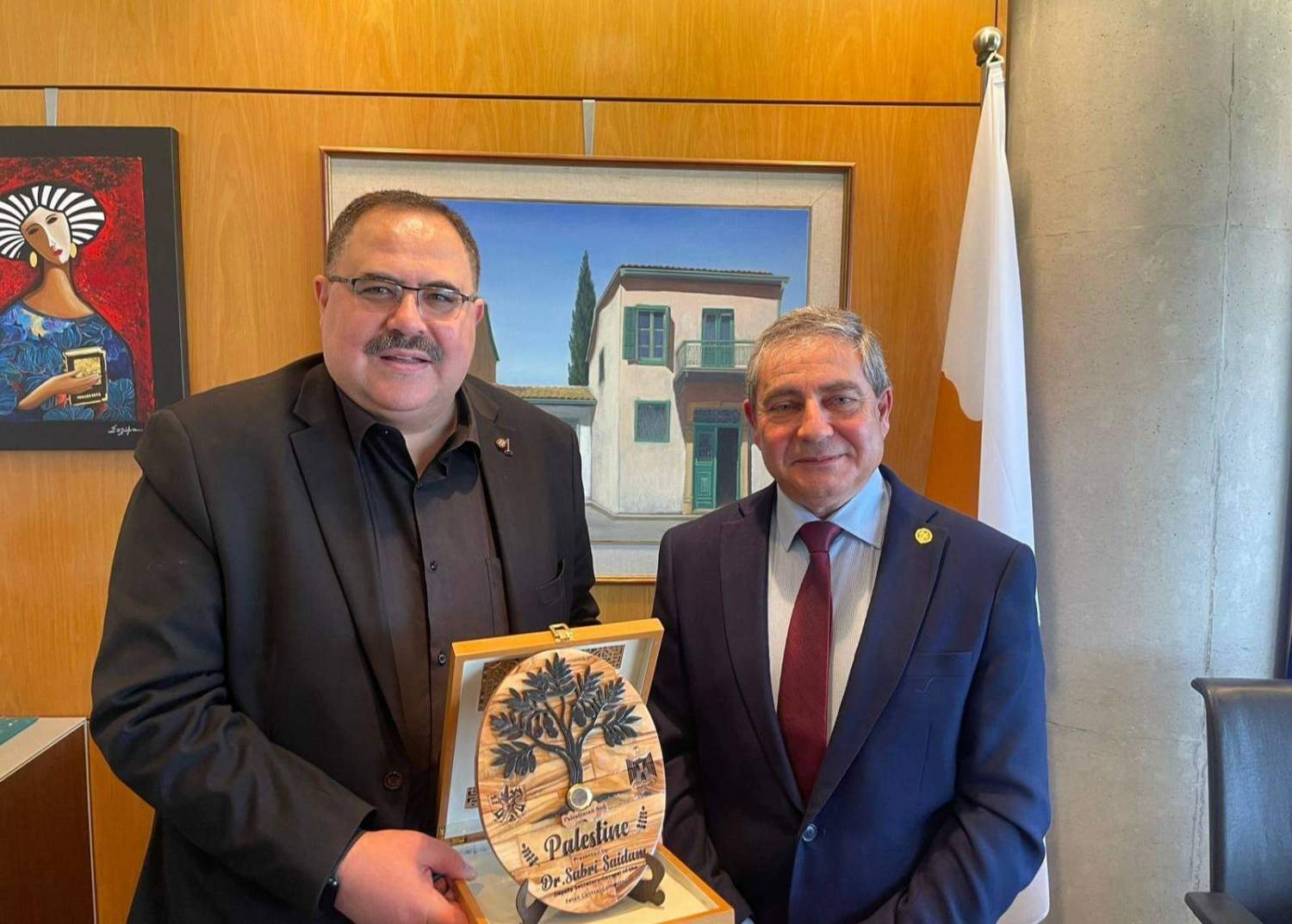
Saidam was in Cyprus during the first week of February for political meetings and public engagements focused on developments in Gaza and the prospects for reviving a credible political process. In this interview, he reflects on the impact of the war on Palestinian politics, criticises what he describes as the failure of international law to protect civilians, and argues that democratic legitimacy and strong institutions remain essential to future statehood. He also warns of the risk of a “lost generation” in Gaza and outlines the role he believes Cyprus can play in advocating for the Palestinian cause.
What is the purpose of your visit to Cyprus, and what do you expect a country like Cyprus to do for the Palestinian cause?
My visit to Cyprus has been very successful. I attended an AKEL study day for European members of parliament, where I spoke about the plight of the Palestinian people, and I also engaged with partners to explore ways of coordinating efforts to end the current situation.
Cyprus has long been a close and trusted partner for many Palestinians and for those who continue to believe that a just solution remains possible. The Palestinian people and their cause view Cyprus as an interlocutor capable of explaining Middle East realities to Europe and of advocating for a more credible and proactive European role.
Placing the Arab–Israeli conflict on the back burner will not lead to stability. What is required is a comprehensive resolution that prevents a return to confrontation and ensures that the will of the Palestinian people is respected and that justice is fully served.
Has the war in Gaza permanently altered the Palestinian national project? Can politics return to the same framework once the fighting ends?
Yes, the war has undoubtedly altered the Palestinian national project. It has deeply affected the Palestinian cause and has also damaged the credibility of the international community, as well as the mandate, doctrine and ethical standing of the United Nations as the guardian of world peace.
What we have witnessed is an accumulation of Israeli hostility, rejection and disregard for the Oslo process, which led to the establishment of the Palestinian National Authority. This situation must now be revisited and thoroughly re-examined by the international community, with a view to exerting real pressure on Israel to abide by the will of the international community as reflected in numerous UN resolutions.
We are extremely concerned about the current situation and firmly believe that without meaningful international intervention, there will be no end to this violence. Otherwise, we risk witnessing further suffering and hardship.
There has been a major dent in global politics and in local Palestinian politics alike. The impact of the current reality has fuelled growing apathy among Palestinians. Those who were once regarded as guarantors of the Oslo process have proven unworthy of that role. They have stood by as the relationship deteriorated, as successive wars unfolded, and as confrontation became the dominant mode of engagement.
The pressing question now is how to mend a situation that has been severely damaged and distorted, and how to end the fighting so that peace can be restored and UN resolutions upheld.
Gaza has exposed the limits of international law. Do you still believe global and European institutions are willing to enforce it when it comes to Israel and Palestine?
I would not say that Gaza has merely exposed the limits of international law. Rather, it has exposed its failure, its bankruptcy and its redundancy when it comes to protecting people in need.
In the eyes of many Palestinians, international law appears to serve those who hold power, while being selectively invoked by those who use it to justify further harm against the Palestinian people, rather than to uphold justice or advance peace.
There must therefore be a serious global effort, particularly by European institutions, to enforce peace and resolve the Arab–Israeli conflict. I still believe that those who are merely observing global developments without acting should step forward and refuse to surrender to pressure or resignation. Collectively, we can make a difference.
Marginalising Europe or pushing it to the sidelines will not serve world peace, nor will it help resolve the Arab–Israeli conflict. The continuation of this conflict only plants the seeds for further confrontations in the future.
What role do governance and institutions play on the road to statehood? Can real state-building take place under occupation, or does it risk becoming an illusion?
Governance and institutions have always played a central role in consolidating the credibility of the Palestinian Authority and in laying the foundations for a future Palestinian state. State-building has long been an integral part of Palestinian political culture, not only to demonstrate readiness for statehood, but also to challenge the false notion promoted by Israel that Palestinians are incapable of self-governance.
No nation is unworthy of freedom. Many nations have struggled in building their states and have ultimately proven their credibility. Over the past 30 years, Palestinians have prepared themselves for statehood, but decision-makers in Tel Aviv have chosen a different path.
Calling for elections offers a clear remedy to a difficult and challenging situation. Democracy remains a key instrument for renewal and legitimacy.
Large parts of Palestinian society no longer trust existing political institutions. What concrete changes—not promises—must Palestinian leadership now deliver to restore legitimacy?
I would not necessarily agree that large parts of Palestinian society no longer trust existing political institutions. That said, the Palestinian leadership and the Palestinian Authority have declared that 2026 will be a year of democracy.
Those who are dissatisfied with the system have the opportunity to change it through the ballot box, and only through the ballot box. This includes municipal elections, presidential elections, elections to the Palestinian National Council, and internal democratic processes within political movements, including the upcoming eighth congress of Fatah.
Those who are unhappy with the status quo can opt for change through general elections and democratic participation. Democracy should be the judge, and the ballot box should determine the way forward.
With schools and universities destroyed in Gaza, how do you prevent an entire generation from being lost politically, socially and intellectually?
Preventing an entire generation from being lost politically, socially and intellectually is undoubtedly a major challenge. However, technology has played a crucial role. Schools in Gaza have used digital tools to remain connected with their counterparts in the West Bank, while universities have maintained academic links to ensure continuity of education for students who have been deeply affected by the war.
This, of course, does not guarantee full efficiency. Restoring educational life in Gaza is essential, just as reconstruction is needed across other sectors. Schools and universities must be rebuilt while ensuring that education continues and gradually returns to normal.
How can technology and artificial intelligence become tools of empowerment?
Technology and artificial intelligence have long been tools of human empowerment. They have also provided platforms that maintain connectivity between schools and universities in Gaza and those in the West Bank.
Every possible effort must be made to safeguard a Palestinian generation that has endured immense hardship, ensuring continued access to knowledge and education. This is vital for sustaining the intellectual capacity needed to support state-building, development and collective progress. Education remains central to all of this.