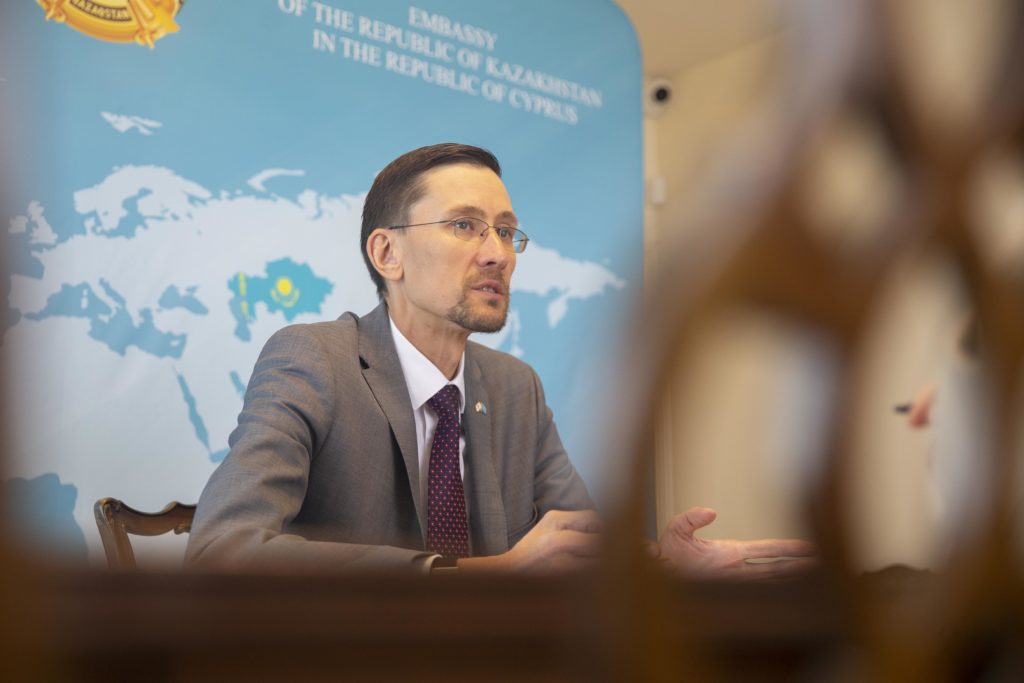

Interview with Andreas Bimbishis and Stelios Marathovouniotis
Kazakhstan has entered a new stage in its relationship with Cyprus by appointing Nikolay Zhumakanov as its first resident ambassador in Nicosia. The decision marks a shift in Astana’s foreign policy footprint in the Eastern Mediterranean and follows a wider expansion of its diplomatic network across Europe and the broader region.
Zhumakanov said the establishment of the embassy reflects Kazakhstan’s view of Cyprus as an important partner within the EU, the Middle East and the wider neighbourhood. A permanent mission, he noted, enables faster political engagement, greater economic cooperation and more consistent follow-up with institutions, businesses and civil society — advantages that were not possible through occasional visits by non-resident ambassadors.
The new presence has already begun to change the pace of bilateral work, with business outreach, investment promotion and political dialogue expanding rapidly. As Astana seeks deeper ties with the EU, enhanced regional connectivity and greater access to Mediterranean markets, Cyprus is emerging as a key platform for advancing Kazakhstan’s diplomatic and economic objectives.
You are Kazakhstan’s first resident ambassador to Cyprus. What prompted Astana to establish a permanent diplomatic presence here after 33 years of relations?
From the early days of our independence, Kazakhstan and Cyprus have enjoyed diplomatic relations. For decades, however, our representation to Cyprus was non-resident: our Embassy in Tel Aviv covered Cyprus, and Kazakh ambassadors based in Israel were concurrently accredited here. They traveled periodically to present credentials and attend events, so there was always a form of representation.
I now have the honor of serving as the first Аmbassador based in Cyprus full-time. We opened our Embassy in Nicosia because Cyprus is an important partner for us – in the EU, the Eastern Mediterranean, and the Middle East. The decision was strongly influenced by Cyprus’s strategic role and the growing interactions between our countries. This step also fits naturally into the broader expansion of our diplomatic network in the region, which recently included new embassies in Albania, Slovenia, Algeria, North Macedonia, and a Consulate General in Montenegro.
Cyprus has likewise upgraded its presence in Kazakhstan, opening an embassy in Astana and appointing a resident ambassador last year.
Beyond symbolic value, what practical advantages does having a resident embassy provide for bilateral relations?
Having a resident embassy completely changes the dynamic of our bilateral ties. When an ambassador lives and works in the host country, engagement becomes far deeper and more immediate. I can meet officials, businesses, academics, and citizens regularly, gather real-time feedback, and react quickly to new opportunities – something impossible with only occasional visits.
This presence already proved its value. A few months ago, we coordinated a visit of eight Cypriot entrepreneurs to Kazakhstan. Because I’m based here, our Embassy worked efficiently with partners in both countries, arranging meetings with Kazakh Invest, the Chamber of Commerce, B2B sessions, and visits to the Astana International Financial Centre and Alatau City – a major new development near Almaty with generous incentives for investors, including zero corporate tax, zero VAT, government-provided land, and flexible labor rules.
The effect was immediate: the delegation returned to Cyprus eager to pursue projects with Kazakhstan. These rapid, tangible results are much easier to achieve with an on-site embassy, where we can follow up daily, connect people, and keep momentum strong.
What is the current economic relationship between Cyprus and Kazakhstan? What is the scale of bilateral trade and investment?
Our economic ties are strongest in investment. While direct goods trade remains modest, capital flows between our countries are substantial. Cyprus, as a major financial hub, has long been a source of investment into Kazakhstan: since 2005, Cyprus-based investors have injected over $4.8 billion, making it one of our top investors. Kazakh businesses have also been active in Cyprus, with around $1.3 billion invested over the years. Today, roughly 360 companies with Cypriot capital operate in Kazakhstan, showing that our financial and corporate links are far deeper than the trade figures alone suggest.
When I speak with Cypriot businesspeople, interest grows quickly once they understand Kazakhstan’s regional reach. Investors in Kazakhstan gain access not only to our market of 20 million people but to the entire Eurasian Economic Union – over 180 million consumers with no customs barriers – as well as preferential access to Central Asia, emerging routes to South Asia, and direct pathways to China. A company operating in Kazakhstan can effectively serve a vast regional market.
At the same time, Cyprus offers Kazakh businesses an ideal launch point into the EU thanks to its business-friendly environment. In short, investment already forms a solid backbone of our economic partnership, and we are now focused on expanding trade by leveraging each other’s strategic advantages.
Which sectors offer the most promising opportunities for Cypriot investors in Kazakhstan?
Kazakhstan has a diversified economy with strong potential in manufacturing, mining and resource-related services, agriculture, and fast-growing areas like IT, digital services, and finance. Our tech sector is expanding quickly thanks to a young workforce and strong government support.
Digitalization is one field where we already have substantial experience to offer. Kazakhstan has built an advanced e-government system: almost every public service – from birth certificates to property records – can be obtained online through our eGov portal and mobile app. This progress placed us 24th in the UN e-government index, ahead of several EU states.
Overall, opportunities span both traditional industries and high-tech fields. Kazakhstan’s regional access, investment incentives, special economic zones, and the Astana International Financial Centre create a favorable environment. My task is to connect these opportunities with the strengths and ambitions of Cypriot businesses.
The sanctions on Russia have significantly impacted regional trade routes. How has this affected Kazakhstan’s economy, and what steps has Astana taken to adapt?
Sanctions have certainly influenced regional trade dynamics, and Kazakhstan has felt some of those effects, particularly in transit and logistics. Traditional routes have become more complicated, which in turn affected the flow of certain goods and created additional pressure on transport chains. At the same time, Kazakhstan has remained focused on economic stability. The approach has been pragmatic: recognize the challenges, manage the risks, and avoid any actions that could expose the economy to secondary sanctions or broader disruptions.
These developments have also accelerated work that was already underway to diversify Kazakhstan’s transit options. The country has invested for years in developing alternative corridors – most notably the Trans-Caspian route, the Middle Corridor – which links Central Asia with the South Caucasus and onward to Europe. Infrastructure upgrades, expanded port capacity on the Caspian Sea, and closer coordination with regional partners have all helped redirect growing volumes of cargo along these new routes. Kazakhstan is broadening its logistical map, turning a difficult geopolitical environment into an opportunity to strengthen its role as a stable and reliable transport hub across Eurasia.
When Kazakhstan announced plans to open a resident embassy in Cyprus, there were reported reactions from third parties. How did your government respond to these concerns?
We indeed noticed some reactions in the press at the time. However, we regard those statements as personal opinions of individual commentators – they do not reflect any official position of any government.
Kazakhstan’s decision to open an embassy in Cyprus was based on our own national interests and sovereign rights. We consider Cyprus a friendly nation, and our move to deepen diplomatic ties should not be seen as controversial. Kazakhstan is a sovereign, independent country with its own multi-vector foreign policy – a principle we have adhered to since independence. The main aim of our foreign policy is to maintain strong, mutually respectful relations with all nations worldwide. We have excellent relations with Russia, China, our Central Asian neighbors, the European Union and its member states, the United States, Turkey – indeed with partners in every region of the world.
In what ways can Cyprus and Kazakhstan leverage their respective memberships in different international organisations to support each other’s interests?
There is a lot of potential for us to support each other on the international stage. To start with, both Cyprus and Kazakhstan are active members of the United Nations, and we find our positions on key international issues to be very similar. We have a solid understanding through the UN framework – we mutually support each other when it comes to elections in various UN bodies.
Beyond the UN, we maintain a constant political dialogue that helps align our approaches in other international fora. As you know, Kazakhstan’s Foreign Minister paid an official visit to Cyprus this March – it was the first ever visit at that level in our bilateral history. Meanwhile, Cypriot Foreign Ministers have visited Kazakhstan multiple times – I believe five visits in total. Minister Kombos was in Astana last year, and President Christodoulides, in his previous capacity as Foreign Minister, visited in May 2019.
Cyprus is a very important partner for us within the European Union. We value Cyprus’s perspectives in EU discussions, especially with Cyprus set to hold the EU Presidency in the first half of 2026. Nicosia can be a voice within the EU that understands Central Asia and advocates for stronger EU engagement with our region.
Conversely, Kazakhstan is a member of several regional organisations – for instance, the Commonwealth of Independent States (CIS), the Shanghai Cooperation Organisation (SCO), and the Organisation of Turkic States (OTS) – and we could serve as a bridge for Cyprus to those regions.
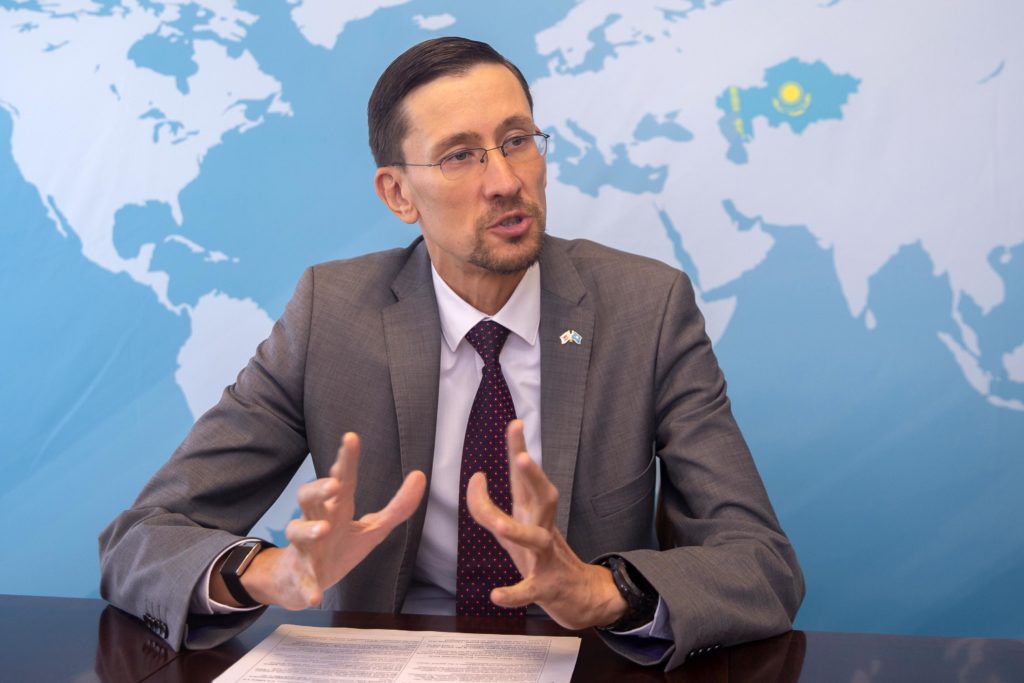
Cyprus assumes the EU presidency in the first half of 2026. What specific outcomes does Kazakhstan hope to achieve during this period?
We view Cyprus’s upcoming EU Presidency as a valuable opportunity to advance some of our key initiatives with the European Union. The most immediate priority on our agenda is the negotiation of a Visa Facilitation Agreement between Kazakhstan and the EU. These negotiations are underway, and we are very hopeful that, with Cyprus at the helm of the EU Council in early 2026, we can accelerate and perhaps even finalize this agreement. A visa facilitation deal would make it easier for Kazakhstani citizens to travel to Europe – simpler procedures, reduced visa fees, and so on – which in turn would strengthen people-to-people contacts and business ties.
In broader terms, under Cyprus’s presidency we hope to see continued momentum in EU–Central Asia relations. Cyprus will have a leadership role in setting the EU’s agenda, so we anticipate it will champion issues like economy, connectivity projects, energy cooperation and digitalization.
How would you assess the broader relationship between Kazakhstan and the European Union?
Our relationship with the European Union is strong and continues to grow steadily. The EU is Kazakhstan’s largest trading partner, and it remains our biggest source of foreign investment – about half of all FDI in Kazakhstan comes from EU member states. This economic weight is matched by an equally solid political and institutional framework.
The cornerstone of our cooperation is the Enhanced Partnership and Cooperation Agreement, signed in 2015 – the first such advanced agreement that the EU concluded with any Central Asian country. It covers 29 sectors and provides structured dialogue through ministerial council, committees, and specialized subcommittees that meet regularly to advance joint work. As a result, Kazakhstan–EU ties are built on trust and practical cooperation. We are constantly expanding the partnership, whether through boosting trade, coordinating on energy and sustainability, improving business conditions, or facilitating travel for our citizens.
What are the prospects for establishing direct flights between Kazakhstan and Cyprus, and what impact would this have on tourism?
The outlook is very promising. We’re working closely to launch direct flights, and there is strong interest on both sides. Air connectivity is essential for tourism and business, yet travelers currently rely on connections through third countries. Even so, the Embassy of Cyprus in Astana already issues 100–200 visas to Kazakh citizens each month, showing clear demand despite the inconvenience.
Direct routes would make travel far easier and could significantly increase visitor numbers. Kazakhstan, with its population of 20 million and strong interest in beach destinations, represents an attractive market for Cyprus. Shorter travel times would also support package tours, family holidays, and business trips.
What tourism attractions can Kazakhstan offer to Cypriot visitors?
Kazakhstan is a country of striking natural diversity, and we would be glad to welcome more visitors from Cyprus to discover it. For those who want a change from the Mediterranean coast, our landscapes offer an entirely different experience. The Tian Shan and Altai mountains provide excellent skiing in winter and beautiful hiking in summer. Near Almaty, resorts like Shymbulak combine modern facilities with dramatic scenery, while nearby alpine lakes showcase untouched nature. The Almaty region also has Charyn Canyon, often described as a smaller Grand Canyon, and the north offers the forests and lakes of Burabay. Travelers interested in unique landscapes can explore Mangystau on the Caspian Sea, known for its surreal rock formations and wide-open plateaus.
Kazakhstan also has deep historical and cultural attractions. Southern regions preserve Silk Road heritage sites such as Turkestan’s UNESCO-listed Mausoleum of Khoja Ahmed Yasawi, along with ancient cities like Otrar and Taraz. And for those drawn to modern architecture, Astana offers a futuristic skyline that reflects the country’s rapid development.
We plan to promote these destinations actively. We will work with tour operators, support new package tours, and organise trips so Cypriot travel agencies can see Kazakhstan’s tourism potential firsthand. We’re confident that, with greater awareness, many Cypriots will be eager to explore a country so different in landscape yet familiar in its warmth and hospitality.
How many Kazakh citizens currently reside in Cyprus?
The number is relatively small but growing compared to larger diaspora communities. According to the latest statistics provided by the Cypriot authorities, there are 555 Kazakh citizens holding permanent residency in Cyprus. These are individuals who have made Cyprus their home long-term – some are working professionals, some have businesses or have settled here with their families.
We will maintain close contact with our compatriots in Cyprus – one of the responsibilities of our new Embassy is consular support and community engagement with Kazakhs living here.