

By Nectaria Georgiadou & Bilun Gunes
This piece was first published on policypress.cy
Cyprus will work towards an “Autonomous Union Open to the World”, Cyprus President Nikos Christodoulides said on Sunday, 21 December, presenting the programme and priorities of the Cyprus Presidency of the Council of the European Union at the Lefkara Conference Centre.
Describing the moment as historic in political, institutional and symbolic terms, Christodoulides said the assumption of the Presidency marks both the culmination of nearly two years of preparation and the start of a “crucial mission with a European and national dimension.” He stressed that the Presidency was treated not as a formal obligation, but as a national mission, coordinated under the guidance of the President and the Council of Ministers, with public administration officials working “with professionalism, dedication and a collective spirit.”
Cyprus’ vantage point at a time of crises
Cyprus takes over the rotating Presidency at what the Cyprus President described as a particularly complex geopolitical juncture, “marked by multiple crises and systemic transformations for the EU. As the Union’s south-easternmost member state and the only one still under occupation, Cyprus brings”, he said, “a distinct understanding of security, stability and international law, approaching the role as an honest, reliable and transparent mediator representing all 27 member states equally.”
“In ten days we assume an institutional responsibility towards Europe, our fellow citizens and future generations,” Christodoulides said, adding that “the heart of Europe beats more strongly in Cyprus” at this moment.
Five interconnected pillars
The Presidency will be guided by five interlinked pillars:
- Autonomy through security, defence and preparedness
- Autonomy through competitiveness
- An autonomous Union open to the world
- An autonomous Union of values for all
- A budget capable of supporting a more autonomous EU
Cyprus, he said, is “ready to lead” for six months as the voice of the 27, coordinating, negotiating and bridging differences as an honest broker, while pushing European integration forward “with confidence and pride.”
Security, defence and resilience
On security and defence, the Cyprus Presidency will prioritise consistent support for Ukraine as a matter of principle and international law, while advancing the implementation of the EU White Paper on the Future of European Defence and the Defence Preparedness Roadmap to 2030. Deepening EU-NATO cooperation, maritime security and freedom of navigation, particularly in the Mediterranean, economic and water security, and protection of democracies from disinformation, cyber threats and foreign interference were highlighted as core priorities.
Migration management will be treated as a central security issue, with Cyprus committing to full implementation of the Pact on Migration and Asylum and to strengthening the EU returns framework in cooperation with third countries.
Competitiveness and energy autonomy
Under the competitiveness pillar, the Presidency will push for administrative simplification, particularly for SMEs, completion of the Single Market, deeper capital markets integration and stronger energy autonomy. Ensuring affordable and predictable energy prices, promoting the EU energy networks package, investing in clean and innovative technologies, enhancing regional connectivity and strengthening digital sovereignty were also outlined as key objectives.
Enlargement, partnerships, and crisis response
Autonomy, Christodoulides said, “does not mean isolation, but extroversion and geopolitical strength.” Cyprus will therefore prioritise EU enlargement as a strategic geopolitical tool, with particular emphasis on Ukraine, Moldova and the Western Balkans, while maintaining engagement with Turkey. Continued EU support to Ukraine, diplomatic, political, economic, military, energy and humanitarian, was described as a central focus.
The Presidency will also work to strengthen relations with the Southern Neighbourhood, the Middle East and Gulf countries, advance the New Pact for the Mediterranean through concrete projects, deepen trade relations and free-trade agreements, and reinforce strategic ties with the United States, the United Kingdom and like-minded partners. Cyprus’ experience in humanitarian missions and evacuations will be leveraged to enhance the EU’s rapid crisis-response capacity.
Values, social cohesion and health
On values, the Cyprus Presidency will promote the rule of law, social cohesion and policies addressing everyday challenges. Affordable housing will be elevated as a European-level social issue, alongside child and youth protection, particularly digital safety and tackling cyberbullying, gender equality, mental health and the strengthening of a European Health Union, including better access to medical products.
Budget and the road ahead
On the budgetary front, Cyprus will work towards shaping a strong Multiannual Financial Framework, ensuring adequate funding for defence, competitiveness, the green transition and social cohesion. The stated goal is to deliver a mature negotiating framework to the next Presidency.
Christodoulides said European integration has always advanced through crises and bold political choices, describing greater European autonomy as the natural evolution of the European project. “For this Union we will work, an autonomous Union open to the world,” he said, calling it the best safeguard for a continent of peace, security and cooperation.
Lefkara symbolism and logo reveal
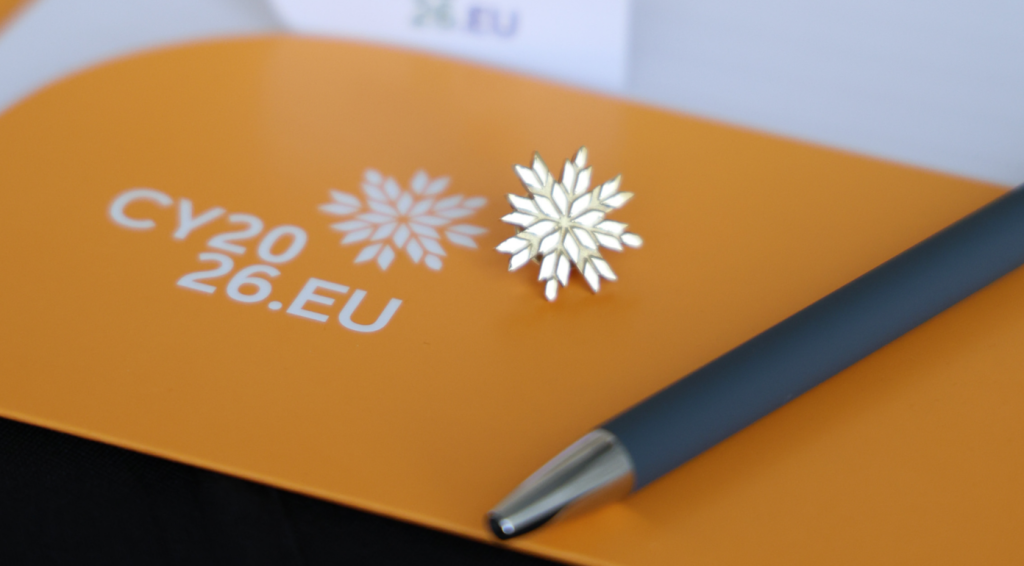
The choice of Lefkara as the venue, the President noted, symbolised creativity, tradition and Cyprus’ timeless outward-looking identity. Following the presentation, the official logo of the Cyprus Presidency was unveiled, inspired by Lefkara lacework and composed of 27 tesserae representing the EU’s member states.
Addressing the event, Deputy Minister for European Affairs Marilena Raouna said Cyprus would host more than 260 meetings across the island during the Presidency, including an informal summit of heads of state or government and 19 informal ministerial meetings, while chairing over 1,500 meetings in Brussels. Around 30,000 visitors are expected, with Cyprus negotiating more than 330 legislative and policy files.
“Our aim is a realistically ambitious Presidency, with tangible results for all European citizens,” she said.
Read more: