

Interview with Androula Taramounta, Andreas Bimbishis, Costas Venizelos and Frixos Dalitis
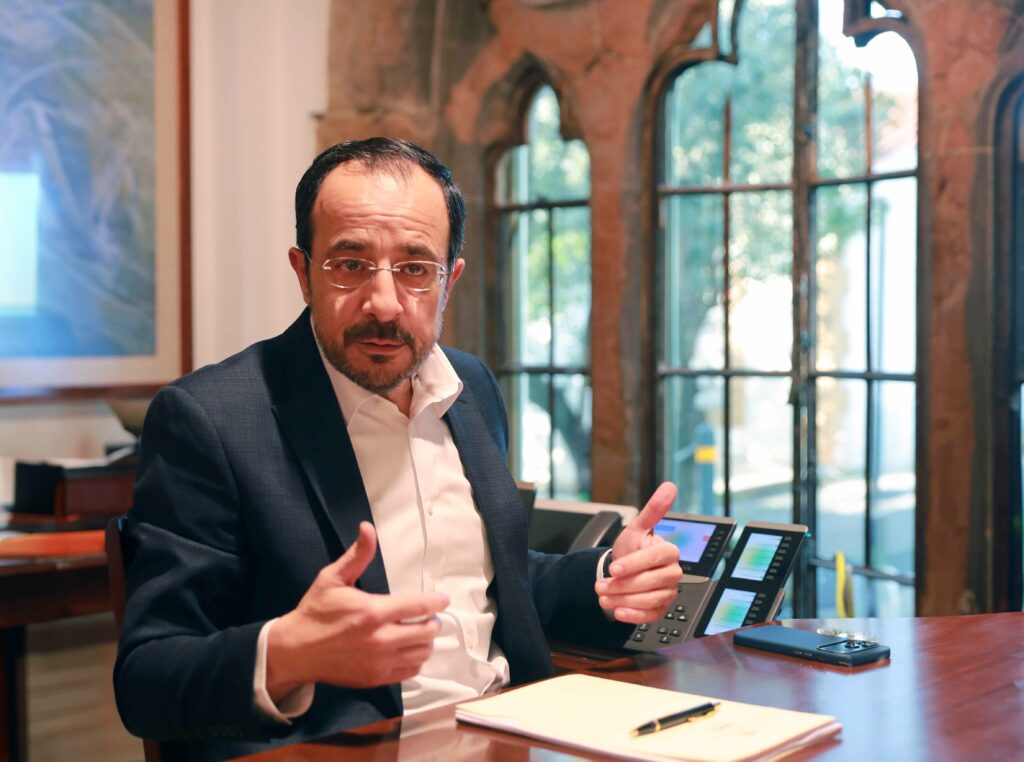
President Nikos Christodoulides has delivered a robust defence of his government’s reform agenda, declaring that his administration “dares, doesn’t back down, and isn’t concerned about political cost” when pursuing changes that benefit the country and its citizens.
In the second part of his interview with Phileleftheros, Christodoulides articulated his government’s ideological framework—centre-right politics combined with social liberalism—whilst outlining ambitious plans including pension reform by 2026 and measures to tackle the cost of living crisis.
“For us, it’s important that the benefits from economic development trickle down to people,” the president said. “Achieving this goal is very important for us, as is our ability to implement targeted social policy”.
‘We dare, we don’t back down’
You managed to get the reforms approved by parliament. Now they need to be approved in the public sphere…
“Yes, it was a very good day for Cyprus at the last session of parliament. After 50 years, we passed teacher evaluation, and after 22 years, tax transformation. What I take away, which has particular significance—and I connect this with the budget vote as well—is the majorities with which the tax reform, the education reform and the budget passed over the last three years. These are some of the strongest majorities that have existed in parliament. And we’re a government that some said wouldn’t get anything through parliament. So for me, that was extremely important.
“Secondly, the fact that we dare to push forward major reforms. Because it’s not easy—you saw that the trade unions were all against the evaluation system. I believe they were wrong, but in any case, we dare, we don’t back down, we’re not concerned about political cost when faced with the broader benefit that reforms will bring to the country and citizens. On tax reform, we proceeded in a very targeted way to address internal challenges. We’re helping families, we’re helping the middle class, we’re helping young people. In other words, where we believe we must make interventions for the good of the country, we dare. And that’s how we’ll continue with reforms.”
The president emphasised that his government’s next major objective is pension reform, targeting 2026 for significant increases, particularly for low-income pensioners.
“This is the goal we’ve set and, from the internal preparatory work we’re doing, it’s an achievable goal, and we will succeed.”
Can the economy support pension increases?
Can the economy sustain pension increases?
“For us, it’s important that the benefits from economic development trickle down to people. Achieving this goal is very important for us, as is our ability to implement targeted social policy. We increased social spending in 2024-2025 by 6%. We’re now coming for 2026 with another 6% increase. So the fact that our economy is following an upward trajectory gives us the capacity to strengthen social policies.
“We’re investing in education and also in health. In education, our goal is to make all primary schools optionally full-day by 2028. You can imagine the benefits from such a development. In health, amongst other things, we’ve announced and are allocating over €126 million for infrastructure, and this is also very important, as a result of strong economic growth and our responsible fiscal policy.”
Christodoulides recalled that in 2024, the government’s first year, the major summer issue was numerous problems in accident and emergency departments. By 2025, significant progress had been achieved with clearly fewer problems, because the administration proceeded with planning, establishing rapid triage centres.
“I went on-site, I heard the problems from people themselves, we pushed forward solutions, and when I visited Nicosia General Hospital again personally, people were satisfied with the changes we pushed through.”
The problems haven’t been fully resolved…
“They haven’t been resolved, but there is significant progress.”
A&E departments are a cancer…
“Yes, but what’s happening now in A&E? We used to go to A&E whether it was a matter of life and death or, for example, a broken leg. But that’s not how A&E works. Now the rapid triage clinics operate and if you’re determined to be a serious case—category 1 or 2—and your life is at risk, you go in immediately for examination at A&E. If you’re not a first-priority case, you go elsewhere. It’s a very important measure. As I mentioned earlier, I went and saw how it works at the general hospital. I spoke with people.”
Housing and social investment
What about the major problem of housing?
“Generally speaking, then, due to economic growth, we’re substantially investing in health, education, social policy and housing. We’ve invested over €300 million within our housing policy framework; we’ve just announced €70 million, and we’ll announce more for housing, because it’s an enormous challenge.
“All these things, for us to be able to do them, mean we have the fiscal capacity, mean the economy is doing well, and on the basis of social liberalism—our ideological-political framework that determines our policies—we’re implementing our electoral programme.”
The president explained his understanding of social liberalism: “We’re in favour of the free market, we’re against uncontrolled state interventions, but at the same time the state has a responsibility, in certain sectors, to return benefits to society in areas such as health, education, housing and the welfare state.”
He highlighted unprecedented measures, including €106 million over three years for policies supporting persons with disabilities—beginning with €26 million this year. The government also addressed the issue of depositors who suffered haircuts in the banking crisis.
“Who believed any government could give money back to those who suffered haircuts? Nobody believed this would happen, but we activated the National Solidarity Fund and returned money to those affected.”
Christodoulides stressed that such measures are possible because the government’s economic policy is responsible and because it’s an administration whose decisions aren’t influenced by electoral cycles.
“We don’t participate in municipal elections, we don’t participate in parliamentary elections. This gives us the flexibility to be more resistant to possible, justified in some cases, demands and pressures that exist especially during pre-election periods.”
The ‘Cyprus model’ for migration
On migration, significant steps have been taken. On one hand there’s the need to reduce migrants, and on the other the need for foreign workers in key sectors of the economy (catering, hotels, construction, etc.). How can this gap be bridged?
“First, I’ll begin by saying that in 2023, during the election campaign, migration was one of the most basic issues, if not the most basic issue. Today the situation is completely different. And the reason is precisely the policy we followed: we reduced arrivals by over 80% and increased returns by over 60%. We implemented our promise for a holistic approach and now Cyprus is no longer an attractive migration destination.
“Before each European Council, we have a group of states, the ‘like-minded group on migration’, and we discuss migration exclusively. And I’m pleased because my colleagues ask to adopt the way Cyprus managed migration—’the Cyprus model’.
“Recently Germany’s chancellor told me that, after such results as Cyprus has, he wants to send his minister responsible for migration here to see the practices we follow. So it’s particularly important that we’ve managed to address migration effectively. There are still challenges, I’m not saying we’ve finished, but certainly the results show the correctness of our approach.”
The president added another dimension: linking external with internal policy and migration. The problem was successfully addressed precisely because the EU sees through Cyprus’s foreign policy that it’s not a single-issue state, but a member state with voice and role in EU policies.
“When we needed the EU’s help on migration, I telephoned the commission president and within two days she was in Cyprus. We went to Lebanon together and addressed a significant challenge. So I repeat: internal and external policy are directly intertwined.”
Balancing labour needs
Christodoulides acknowledged the dual challenge: labour needs in industry, tourism, agriculture and other sectors, plus the need for scientific personnel.
“We want to bring scientific personnel and we’re pleased that unemployment rates are at 2008 levels, with conditions of full employment. And it’s interesting to compare with major European economies—Germany, France—to see the growth rate, unemployment, public debt.”
He noted that during a visit to France, the first economic topic discussed with the French president was public debt as a percentage of GDP. Cyprus needed to go below 60% by the end of 2026 and is already below that threshold, targeting close to 50% by year-end 2026.
“All this isn’t accidental. It’s the result of our responsible and serious policies, on the basis of our ideological-political orientation.”
For scientific personnel, the government launched the “Minds in Cyprus” initiative within the brain gain framework, offering tax incentives and school benefits. Some 500 people have expressed interest through the platform connecting companies seeking staff with Cypriots wanting to return from abroad. Presentations will continue in 2026 in Thessaloniki, Birmingham, New York and the UAE.
For labour, the agreement with Egypt is very important—a country from which workers coming to Cyprus don’t tend to become asylum seekers. The government will also announce in early 2026 additional working hours for students from third countries studying in Cyprus, always in consultation with employers’ organisations and trade unions.
“We consider and approach them as partners.”
The cabinet recently decided to establish special criteria for collective accommodation units, primarily for workers, modelled on student residences, ensuring that economic success and the need for foreign labour in Cyprus don’t have negative impacts on Cypriots regarding housing.
But workers who come have a cost regarding wages. They push wages downwards…
“No, because they enter with the minimum wage, which we’ve already increased twice under our governance, and work within a framework so they don’t have different employment terms. What you’re saying relates to illegal foreign workers. That’s why migration had to be addressed first, illegal workers had to leave, we had to stop being an attractive migration destination in order to address such phenomena.”
Three major challenges ahead
The president outlined three major challenges his government faces with concrete plans to address them.
First, electricity costs affecting households and businesses and, by extension, the economy’s competitiveness. Cost reduction is a basic objective to be addressed through help and cooperation with regional states.
Second, housing—which is why investment continues. Through the government’s insistence, housing, which is a matter of national competence, was elevated to a European issue. The commission president recently announced a plan for affordable housing, and within 2026 there will be an EU funding instrument for housing.
Third, the cost of living. “I know the data, I’m not disconnected from reality. Many Sundays I go to the supermarket with my young daughter and see the prices, talk to people. There was inflation before assuming governance for exogenous reasons: Covid, Ukraine, etc. We had inflation averaging 6%-7%. Today inflation in Cyprus is amongst the lowest in Europe. But prices remained at high levels. So what can we do? We must strengthen people’s purchasing power and reduce the cost of necessary expenses.”
The goal is to reduce electricity prices, increase purchasing power through the automatic cost-of-living allowance (COLA) and other interventions such as the current tax reform and minimum wage increase.
“The COLA agreement isn’t perfect. If it were exclusively our decision, it would be different. But the fact that 50,000-55,000 workers were added as COLA beneficiaries is important. Regarding the national minimum wage, it’s the second significant increase since the day we assumed governance. Also, with tax reform we’re strengthening the middle class, families, increasing disposable income.”
COLA and minimum wage increases, however, provoke reactions in the business world…
“It’s natural they provoke reactions. We don’t fear reactions. Generally, reforms also provoke reactions. We respect everyone’s view, but we must proceed with important reforms, with changes that must happen for the good of the country and society.”
Pension reform: €510 is unacceptable
“Pension reform is also very important. For us, it’s unacceptable that the low pension is around €510. We fully understand that someone cannot live on €510. That’s why we’ll proceed with pension reform—the first since 1980. And it comes following both tax reform and teacher evaluation and other important reforms we’ve pushed forward.
“I go to the legal service and the audit service: who dared touch these issues? We did. We pushed forward the attorney general’s unaudited status. These issues weren’t touched since 1960. We dared and touched them, because modernising the state of 1960 is for society’s benefit.”
The president reiterated his framework: “I say it continuously, because it has significance: centre-right government, social liberalism, five specific priorities as a government. Strong, resilient economy. Security—and security includes foreign policy, defence and migration. Reforms. Transparency, accountability, combating corruption. And the fifth pillar is the citizen’s daily life: health, education, housing and everything affecting their daily life. So the direction we want to take the country is crystal clear.”
Organised crime and prison control
The issue of citizens’ insecurity due to organised crime remains. There have been three personnel changes at the justice ministry without solving the problem. Central Prisons are controlled by the ‘Cypriot mafia’. Can this problem, which is a chronic cancer, be practically addressed?
“There’s no question for us whether ‘it can be addressed’. We’re obliged to address it and we will address it. Yes, there have been changes at the justice ministry. It’s a ministry where historically there are the most ministerial changes. Beyond that, there’s continuity in implementing our policies. For the prisons issue, it’s important to immediately appoint a director and have a permanent state of affairs.
“And the other thing I requested, and we see happening, is police presence outside. The police must be visible to people. But we cannot and it’s unfair to nullify the police’s work. On migration, for example, the police’s role was and is decisive in addressing it. Also the police’s role in addressing violence at football grounds and hooliganism is very important and delivering results.
“Let me give you another example of important results in the effort to combat crime: after the FBI came to Cyprus and made specific recommendations, we now have a working group in which MOKAS [the Unit for Combating Money Laundering], the tax commissioner, customs, the police and the legal service participate. And they function together, collectively, in investigating cases. It’s now very important that cases of crime are continuously investigated—because this is also crime—where for example someone has an expensive car but at the same time is a recipient of Guaranteed Minimum Income. These issues are being investigated for the first time and cases are proceeding before the courts.”