

Animals have culture too. Or, more precisely, their own cultures, passed down from generation to generation, shaping how they cooperate, communicate and survive. Behavioural ecologist Danae Papageorgiou, head of the Emmy Noether research group at Humboldt University in Berlin, explains why this hidden side of wildlife deserves recognition as part of the world’s heritage. She has co-submitted a proposal to UNESCO on the need to protect animals’ cultural traditions.
Until recently we believed culture was an exclusively human trait. What exactly do we mean by the term when we apply it to animals?
The term “culture” corresponds more closely, in English, to “civilisation,” whereas “animal culture,” which is what we study, corresponds more closely to the cultures of animal societies. In many species, specific groups or populations have socially learned behaviours, rules, traditions and knowledge that can be passed on to future generations and that differ from those of other groups. These cultures can be important for adapting to changing environments, since they offer solutions to new problems.
Could you give some examples of animal cultures you find impressive?
Chimpanzee populations have developed various ways of using tools: treating wounds with leaves, cracking nuts, and extracting termites from their nests using long sticks or blades of grass. Dolphins use socially learned strategies to catch prey. Some of these strategies are cooperative and even involve humans. For example, several dolphin populations around the world cooperate with fishermen. In Brazil, dolphins drive shoals of fish towards the shore. The fishermen cast their nets when they get a signal from the dolphins, and both sides maximise their catch as a result. Another example of cooperative foraging between humans and animals is honey hunting, practised by people and honeyguides (a type of bird) in parts of Africa. The birds lead people to trees containing wild bee nests, and people reward them by leaving behind wax.
Which species has surprised you most?
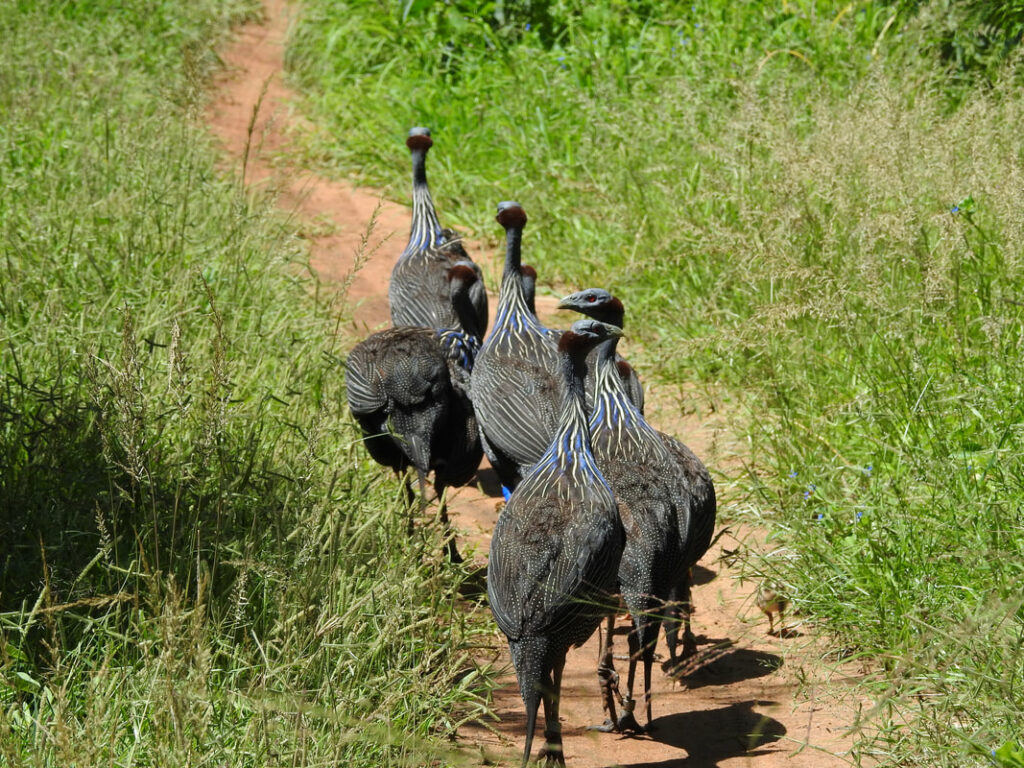
Vulturine guineafowl. Despite having small, not very densely connected brains, they form a multi-layered society similar to that of primates such as humans, elephants and bonobos.
If we moved a young individual from one population to another, would it learn the traditions of its new group?
In some parrot species, newcomers pick up the local dialect. But there are also cultures, such as the use of sponges as tools to forage for food among the dolphins of Shark Bay in Australia, that are learned only from the mother by her calf, and not later in life.
In your proposal with Katariina Hynninen and Jonathan Birch, “Protecting Animal Cultures as World Heritage,” you argue that UNESCO should create a new category to protect “non-human cultural heritage.” What are your main arguments?
Animal cultures help animals survive, and in doing so support biodiversity. The value of culture for survival is starkly illustrated by the difficulty of reintroducing captive animals into the wild.
For example, for great apes to survive in the wild, they need to know which plants are safe to eat, which animals to hunt and how, and these are skills that young animals learn from adults. In cetaceans, communication systems and skills are an integral part of belonging to the group.
Second, culture contributes to a full and “flourishing” life for animals. Welfare isn’t limited to survival: animals have cultural needs, and meeting them is essential to their wellbeing. For example, whales and dolphins are likely to experience stress when their communication is disrupted by underwater noise, but the problem probably isn’t limited to immediate stress. Their ability to coordinate with other individuals, and to learn the group’s unique hunting techniques, is also undermined, and this should be recognised as a serious risk.
Furthermore, studying animal culture broadens our understanding of complexity in general, and of the complexity of animal social life in particular. Human cultural heritage is also often linked to non-human culture. In cases where human migratory routes, rituals, art and literature have been shaped by encounters with non-human cultures, that non-human element can be considered part of our shared cultural heritage.
In the same paper, you argue that the exclusive focus on habitat protection in UNESCO’s World Heritage Convention isn’t enough to protect animal cultures…
Protecting habitat alone overlooks valuable cultures that develop in partly urbanised or heavily human-shaped environments. Examples include the aforementioned cooperative fishing between humans and dolphins, as well as the cooperation between humans and honeyguides in the search for honey. Honey gatherers in different parts of Africa use different sounds to communicate with the birds. Preserving this diversity matters, because birds in each area may only recognise the sounds they’ve learned.
But habitat protection alone also overlooks the importance of certain individual animals in passing on knowledge from generation to generation. Certain “key individuals” play a decisive role in preserving important ecological knowledge. A classic example is older matriarch elephants, who lead the herd to water sources during droughts while passing on migratory routes and predator-avoidance strategies to younger generations.
Even when a habitat is protected, these individuals can be seriously threatened, for example by poaching, when they leave the protected area. In many species, older individuals have particular value, as their knowledge and decisions contribute to the stability of the whole group or population. Yet their age often makes them more vulnerable. Monitoring and protecting them could bring disproportionately large benefits for preserving cultural diversity.
You mention that underwater noise pollution and other human interventions can disrupt animals’ social structures. Is this a threat we underestimate today?
Some forms of environmental degradation, which might not initially seem particularly serious from a species or habitat protection standpoint, can have devastating consequences for animals’ cultural lives. For example, whales and dolphins can adapt to increasing underwater noise pollution by increasing the intensity or duration of their vocal signals. However, this adaptation can significantly hinder cooperative communication between group members.
In addition, underwater noise can interfere with the acoustic signals whales use to navigate during migration, forcing them to abandon routes followed for centuries. This changes not only migratory routes but also animals’ social organisation, as it reduces opportunities to gather, strengthen social bonds and exchange knowledge.
Noise pollution is also a problem for land species. Savannah sparrows, for instance, have distinctive song repertoires that differ between populations. Because of human-generated noise, birds in urban areas have been observed to increase the frequency of their song. This can affect their ability to distinguish the features of songs used in mate selection.
If UNESCO accepted your proposal, what would the criteria be for classifying an animal behaviour as “cultural heritage”?
An eleventh criterion would be added to the existing ones: “To represent an outstanding example of animal culture, exhibiting patterns of behaviour and social learning that form an integral part of the traditions and ecosystems of an animal species, population or group.”
In your view, what would be the most representative example of animal culture worth protecting, and why?
Orca hunting strategies, chimpanzee tool-making and tool-use techniques, and the various forms of cooperation between humans and dolphins observed around the world. In future, a detailed framework will need to be developed for assessing and including candidate animal cultures on the World Heritage List.
As a first step, we propose focusing on examples of cultural behaviours that increase animals’ survival chances and don’t cause significant conflict between humans and wildlife. These represent the clearest cases of cultures with major importance for biodiversity conservation, whose value isn’t fully captured through species or habitat protection alone.

Cyprus lies on one of Europe’s most important migratory corridors. How important is social learning in getting younger birds to follow the right routes?
Very important. There are reintroduction programmes for extinct species, such as the northern bald ibis, in which researchers teach young birds the migratory route by flying ahead of them in small aircraft, because on their own they don’t know where to go.
Could a change in a migratory route, due to climate change or habitat loss, also lead to the loss of an animal culture?
Unfortunately, yes. In many species, such as storks, migration appears to be declining over the years. More and more individuals are wintering in Europe because of climate change and milder winters, feeding at landfill sites instead of travelling to sub-Saharan Africa, as they had done for thousands of years.
The image of the “alpha” male has dominated public perception for decades. Your recent research, however, shows that in animal societies power is often contested and inequality is often balanced out…
The image of the all-dominant “alpha” male is, at best, incomplete. Power is frequently kept in check in animal societies, and powerful individuals tend to pay a steep price for exercising power in one area, such as monopolising food, by losing influence in another, such as directing collective movement. Inequality isn’t unique to human societies. On the contrary, in many group-living species, from vulturine guineafowl to bonobos, chimpanzees, mandrills and hyenas, we observe equalising behaviours that limit or regulate power differences.
Whether these emerge depends on the balance between costs and benefits. When, for example, powerful animals behave aggressively to secure better access to food or mates, other group members may respond collectively. In vulturine guineafowl, when alpha males monopolise food, the subordinate individuals who are excluded may leave en masse, forcing the dominant individuals to follow them.
Similar inequality-equalising strategies, which carry a social cost, are also observed among human hunter-gatherers, through criticism, ridicule, disobedience or even the expulsion of powerful individuals.
How are collective decisions made?
Decision-making processes for group movement are usually participatory, with individuals who have no strong preference following the majority when directions of movement differ greatly. If disagreements are small, say less than 95 degrees apart, followers move in an intermediate direction, thereby balancing out the differences. Dominant males or females have no greater say in these processes, and we’ve shown this in groups of birds, fish, ungulates and primates.
Do you see common principles between how human societies and animal societies manage power and inequality?
I’d say non-human animals don’t have to contend with institutionalised forms of power, such as a state that legitimises and defends inequality. So the equalising processes animals display are often enough to bring about a more equal distribution of resources.
In human societies, by contrast, it seems that coordinated, larger-scale responses to inequality are needed, such as the uprisings and revolutions seen throughout human history around the world.
How do you arrive at these conclusions?
My new research group, Emmy Noether, at Humboldt University in Berlin, plans to draw on publicly available datasets from long-term, cross-species studies. Modern technology also makes it possible to film behaviour in the wild in detail using drones, and to collect movement data using GPS trackers fitted to groups of animals. Non-invasive playback experiments and non-invasive experiments at concentrated food sources can be used to simulate aggressive behaviour by dominant individuals and to better understand the equalising responses that follow. By combining these different methods, over the next six years I aim to investigate the conditions under which the threshold of tolerance for inequality is exceeded and equalising behaviour is triggered.
Was there an experience that led you to dedicate your research to animal social behaviour?
From a young age I rescued stray cats and dogs that were unwell or in danger, and I was also a competitive equestrian with a great love of horses. But that sport is very classist, and I never felt I belonged in that world. So I studied biology, specialising in the social behaviour of non-human animals, which allowed me to travel all over the world, to different ecosystems, studying various species of birds and mammals.
What does a typical field study look like?
In my field, identifying individuals is very important and takes years to set up and refine. With birds, we usually fit coloured rings, unique to each individual, while with dolphins, which I’m studying at the moment, we identify individuals by the markings on their dorsal fin. Then, using new technology such as drones, we record their behaviour, and afterwards, in the lab, we analyse the data.
Which trips and studies have stayed with you?
For my master’s, I spent two to three months on Antikythera, studying the migratory behaviour of the woodchat shrike. The weather was bad, though, and for a few weeks we didn’t have enough food, so we ate very sparingly, but as a team we also felt we were on an important mission to protect the birds. That adrenaline made me want to be out in the field all the time.
For my PhD, I spent a total of 15 months in the Kenyan savannah, studying vulturine guineafowl, surrounded by elephants, leopards, baboons and other savannah animals.
Every day was a surprise. A cobra in the toilet bowl! A monkey climbed through my hut window and stole all my biscuits! One night, driving along, we spotted a rare aardvark!
In Australia, where I’m now studying dolphins, every day is also an adventure. At night the sky lets you see every star and galaxy, and in any case, as researchers we live communally, cook together and support one another, being so far from our usual support networks.