

Archaeologists have discovered an in situ working floor up to 12,000 years old at the Drousha-Skloinidia archaeological site on the Akamas peninsula, marking the most significant find of this year’s excavation.
The working floor includes pieces of unprocessed raw materials, cores, hammerstones and flakes, providing initial information about some of the tasks carried out at Skloinidia by its inhabitants, the Department of Antiquities announced.
Beads, grinding stones and other stone tools, bones and shell objects complete this year’s collection of portable archaeological finds, according to the announcement.
An exceptionally rich shell assemblage raises questions about the full range of activities that took place at Skloinidia aimed at exploiting the area’s natural resources.
The excavation was conducted between September and October 2025 in the northwestern part of the Akamas peninsula under the direction of Theodora Moutsiou, a specialist scientist at the University of Cyprus Archaeological Research Unit, in collaboration with Christian Reepmeyer, an archaeologist at the German Archaeological Institute.
Undergraduate and postgraduate students from the universities of Cyprus, Athens, Cologne and Rome III participated in this year’s expedition, according to the department.
The excavation is part of the research programme “Exploring the role of coasts in the early prehistory of Cyprus: Integrating archaeological excavations and geospatial technologies at the remote Akamas promontory” (Project TOPOS), funded by the Leventis Foundation.
Nine new trenches were excavated in 2025, with one dug to the natural substrate to better understand the site’s formation processes.
The remaining eight trenches were excavated to a depth of approximately 20 centimetres to clarify the nature of an unusual magnetic anomaly detected during previous geophysical survey work.
The excavation of this last set of trenches revealed the in situ working floor, according to the department.
This year’s excavation recorded hundreds of lithic artefacts with typo-technological characteristics that place them at the end of the Pleistocene – Early Holocene period, 12-8 thousand years ago.
Preliminary radiocarbon dating AMS 14C on charcoal samples provides a terminus ante quem of approximately 8000 cal BP.
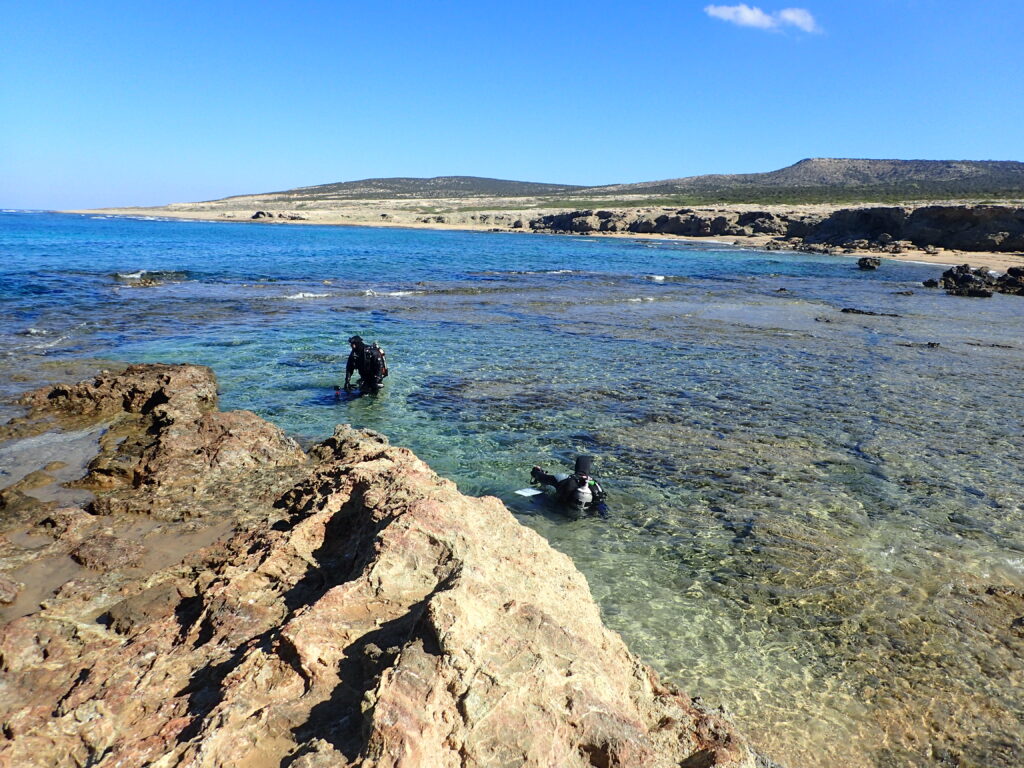
Field work also included a brief underwater survey aimed at assessing the potential preservation of archaeological remains and geomorphological features that might indicate past human use.
Given that when Skloinidia was inhabited, at least 8,000 years ago, sea level was approximately 15 metres lower than today, the current reef area would have been exposed and accessible to humans for exploitation.
Preliminary field observations by divers Filip Hajek of Masaryk University’s Department of Archaeology and Museology and the Institute of Archaeology at the Czech Academy of Sciences, and Christos Patsalidis of Amber Training & Support Services Ltd, confirm a complex marine cultural landscape, demonstrating the need for systematic underwater study.
The site adds significant new data to existing excavations shedding light on early Neolithic Cyprus, highlighting it as a dynamic element of the period’s cultural processes in the wider region, according to the department.
The University of Cyprus’s third expedition to Drousha-Skloinidia is expected to take place in September 2026.